Tree Commission proposes stormwater‑fee changes to recognize trees and depaving
Summary
Tree Commission member Tyler Miller proposed revising Charlottesville’s stormwater fee to factor percent impervious coverage, remove rounding, add waivers for small lots and affordable housing, and credit existing large trees and plantings; city staff said a work session is planned to study potential changes.
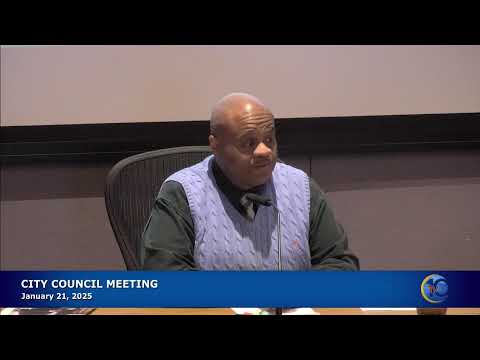
Tyler Miller, a member of the Charlottesville Tree Commission, presented a set of proposals to the City Council on Jan. 21 intended to better recognize trees and natural infrastructure in the city’s stormwater fee.
Miller said the current fee calculation — dividing total impervious area by 500 square feet, rounding up, then applying a fee rate — treats all impervious surfaces equally and does not account for whether runoff is captured by trees or green infrastructure. He said the commission’s suggestions include accounting for the percentage of impervious coverage per lot (not only raw square footage), removing the rounding‑up step, and creating targeted waivers or credits for existing large trees or newly planted, qualifying trees.
"A mature tree respirates hundreds of gallons a day of water out of the soil...and there isn't currently recognition of that, either value or of that financial contribution," Miller said, arguing that trees provide measurable stormwater services.
Miller offered policy examples and technical options: using a percentage‑coverage metric to distinguish parking lots routed directly to streams from driveways that drain to tree wells; designing a scaled waiver that protects small residential lots from disproportionate fees; and creating an affordable‑housing waiver to avoid penalizing new units designed to increase density.
Miller said he found other Virginia jurisdictions that use different fee systems — Arlington and Chesapeake use an equivalent‑unit approach and Blacksburg uses a flat rate — but he was not able to identify another example that incorporated percent impervious coverage the way he proposed.
City staff said the stormwater utility is complex and needs review; the City Manager told council the utility was due for a 10‑year review and that staff plan a council work session later this year to analyze the utility and any recommended changes. Staff also said Miller offered a scenario‑analysis tool that he would make available to city staff to speed technical modeling of policy options.
Councilors asked about equity impacts for small lots and renters, the staffing required to implement a more complex fee, and whether changing the fee would lead to measurable land‑use shifts or simply raise revenue. Miller and commissioners emphasized waivers and administrative tools as part of their approach and framed the proposal as the beginning of a staff‑led policy analysis rather than immediate rule change.
AI generated
The text on this page is AI generated. Summaries, highlights, analysis, and video transcripts are all produced from the original source material.
AI can make mistakes, so if you spot one, and we will fix it for everyone.
Note: the source content is unaltered by us. Any content source we link to, be it a video, an audio recording, or a document, is presented exactly as its publisher released it. That publisher is usually a government body, sometimes an individual official or another organisation.