Lifetime Citizen Portal Access — AI Briefings, Alerts & Unlimited Follows
Census Bureau demonstrates data.census.gov and OnTheMap in employment-data webinar
Loading...
Summary
The U.S. Census Bureau offered a hands-on webinar showing how to find and map employment statistics using data.census.gov and the LEHD OnTheMap tool, using Manchester, N.H., as a demonstration to highlight employment rates, commuting patterns and tract-level unemployment hotspots.
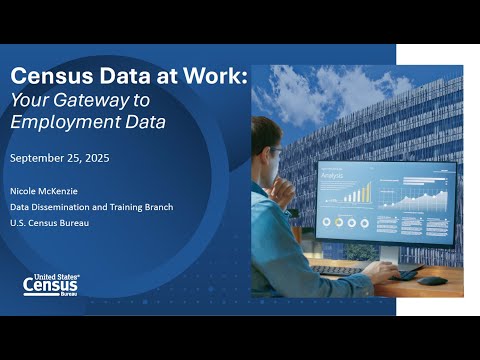
The U.S. Census Bureau held a virtual training session that walked data users through how to find, download and map employment statistics using data.census.gov and the LEHD OnTheMap tool, presenter Nicole McKenzie said during a live demonstration.
McKenzie, a Census Bureau data dissemination specialist, told participants the bureau’s employment resources can answer core questions about who is working, where jobs are located and how pay and commute patterns vary over time. "The workforce is really the engine that drives economic opportunity," she said.
Why it matters: Census employment data are free, publicly available and designed to work at multiple geographic scales, from national trends down to census tracts. McKenzie said local officials, grant writers, researchers and businesses use the information for workforce development, site selection and program evaluation.
What the webinar showed: Using Manchester, New Hampshire, as an example, McKenzie demonstrated both a quick profile view and more detailed, filtered searches. In the profile view she highlighted a Manchester employment rate of 68.5% and noted commute and mode-of-transport figures: an average commute time of about 24 minutes, 71.7% of workers driving alone, roughly 9% carpooling and about 13.6% working from home. She also noted that education and health care/social assistance together accounted for about 23% of Manchester’s jobs in the demonstration.
Tools and techniques: McKenzie recommended data.census.gov as the primary portal for many requests, showing how to use the general search and the advanced search's filter basket (by geography, topic, survey and year). She demonstrated data profile tables (DP02–DP05) and their comparison tables (CP02–CP05), explaining that comparative tables show trends across years and asterisks mark statistically significant changes. "The tool I use the most when I get a request for someone looking for information," she said of data.census.gov.
Granular mapping: The presenter demonstrated mapping table rows to census tracts and cautioned that tracts can cross municipal boundaries. In the demo she identified Census Tract 11 in Manchester as having the highest number of unemployed people, and showed how users can switch between percent and count views or click into tract profiles for more context.
OnTheMap example: McKenzie then demonstrated the LEHD OnTheMap tool to visualize where workers live and where they work. Using 2022 LEHD data, she showed industry filters (for instance, highlighting hospital locations such as Elliot Hospital and Catholic Medical Center) and inflow/outflow results: roughly 21,000 people both live and work in Manchester, about 38,000 Manchester residents commute out of the city for jobs and about 52,000 nonresidents commute into Manchester for work. She suggested those flows can be useful to businesses assessing whether a city has enough workers within commuting distance.
Choosing the right source: In the Q&A, McKenzie recommended the American Community Survey (ACS) and LEHD as common starting points for employment research, but advised choosing a source based on the needed geography and recency. She explained that ACS 1-year estimates are available only for geographies with populations of 65,000 or more and that smaller areas require ACS 5-year estimates. She also advised users to consult table notes and margins of error, and to use the Census API for programmatic or technical workflows.
Follow-up and materials: Webinar materials and any unanswered Q&A will be posted to the Census Academy site within 30 business days. McKenzie and the Census data dissemination specialists offered follow-up training and individualized help (AskData@census.gov), and closed by listing commonly used table IDs for participants who wished to reproduce the demo (DP02, DP03, DP04, DP05 and their CP counterparts).
The webinar ended with brief closing remarks from Crystal Jimerson and an invitation to complete the session evaluation. The recorded session and supplemental materials will be posted to the Census Academy page for participants to review.