Get Full Government Meeting Transcripts, Videos, & Alerts Forever!
Get email alerts on the HNL Build topic
No spam. Unsubscribe anytime.
Honolulu DPP outlines HNL Build fixes after rollout and signals ~ $200,000 enhancement request
Summary
The Department of Planning and Permitting told the City Committee on Government Efficiency that most post‑go‑live data migration problems with HNL Build were identified and fixed, that account creation and AI prescreen tools are reducing review cycles, and that the department will seek about $200,000 for additional enhancements in the next budget.
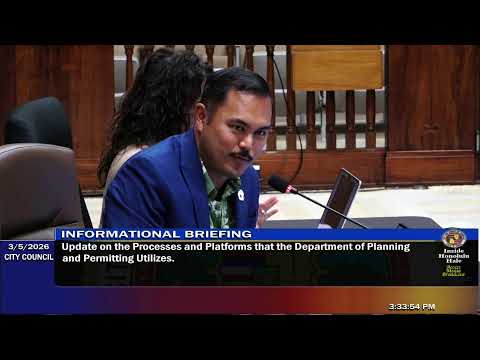
Don Takeuchi Epuna, director of the Department of Planning and Permitting, told the Honolulu City Committee on Government Efficiency and Customer Services on March 5 that the department has moved most permitting workflows to HNL Build and is continuing to refine the system following an August 2025 launch.
"Technology, processes, and people are how we are fixing the department," Epuna said, framing HNL Build together with ePlans (Evolve) and the SivCheck AI tool as a coordinated modernization effort. He told the committee that the department is more than halfway through its implementation plan and that refinements and contract adjustments are expected as part of normal project oversight.
Abe Toma, DPP's applications platform administrator, described the contract structure and the post‑go‑live issues the city encountered. Procurement used the NASPO ValuePoint Master Price Agreement; Carahsoft serves as the prime contractor, Clarity is the product/vendor hosting the platform, and Spiridian handled implementation and will provide managed‑services support. Toma said data migration was the chief technical challenge because POSSE, the legacy system, contained 28 years of highly customized records that did not map cleanly into the commercial off‑the‑shelf Clarity platform.
"We identified most of those issues in the first month or so after go live, and ... we corrected it within that time frame," Toma said, describing a process of staff reports, Jira tickets, targeted remapping and reuploads, and follow‑up user testing.
Toma and Epuna also outlined how the move to HNL Build changes user access and support. HNL Build requires user accounts where POSSE did not; a surge team handled initial demand and DPP now maintains an in‑house tier‑1 and tier‑2 support team that handles account creation and common user problems, with Spiridian as tier‑3 for code or workflow changes. Toma reported that initial account creation volume was about 2,000 in the first month after go‑live and has since leveled to about 600 new account requests per month, with current turnaround for account requests averaging about one business day.
The department provided early performance figures for SivCheck, the AI prescreen tool used on 1‑ and 2‑family residential projects: 64 SivCheck accounts had been created and 39 permits had run through the tool. DPP presented comparative metrics showing reduced prescreen cycles (about 1.6 prescreen cycles down to 1), fewer code‑review cycles (about 2.3 down to 1.4), a drop in total corrections (from roughly 23.2 to 8.8 on average), and a reduction in average days in city review from about 68 days to 33 days for the sample group run through SivCheck. Epuna and Toma said the department plans to require SivCheck for all 1‑ and 2‑family residential submissions and to open commercial permit use in the summer.
On enforcement, Toma said DPP has increased code‑enforcement activity (2,300 total violations in 2025, with sidewalk violations accounting for more than a quarter) and continues to explore process changes to reduce congestion at the Zoning Board of Appeals.
Regarding contracts and costs, Toma said a set of additional enhancements — items not fully scoped or recognized until staff worked in the live system — is under discussion with Spiridian and could require an additional budget request "probably in the 200 k range." He said a managed‑services contract with the implementer was part of the original plan and that Spiridian will provide tier‑3 support as the city moves from implementation to managed services.
Toma also explained the city's approach to legacy data: the department initially loaded roughly seven years of production data into HNL Build to limit production storage, will maintain an archive server for older historical records, and keeps POSSE in a read‑only state so staff can access and migrate older records into HNL Build when necessary.
Council members pressed staff on several points, including whether mapping issues were due to differences in software labeling (staff confirmed mapping and inconsistent historical entries caused many problems), the composition of dedicated support resources (DPP has hired an in‑house person for HNL Build emails and leverages DIT customer support resources), and how Carahsoft, Spiridian and Clarity coordinate (Toma said Spiridian works on scope and development and Carahsoft, as prime, administers contract changes to the city).
The briefing ended with the chair thanking the department for the update. No formal committee vote was taken on the briefing; the department said the additional enhancement budget will appear in the forthcoming budget presentation.
Ending: The committee had no registered public testimony on the item and moved to the next business.