Lifetime Citizen Portal Access — AI Briefings, Alerts & Unlimited Follows
Senator presses Chairman Carr on FCC authority to police political satire
Loading...
Summary
In a Senate hearing exchange, a senator asked Chairman Carr whether the public-interest and news-distortion standards let the agency police political satire or revoke broadcast licenses; Carr said the agency enforces statutory public-interest rules and distinguished satire from broadcast hoaxes.
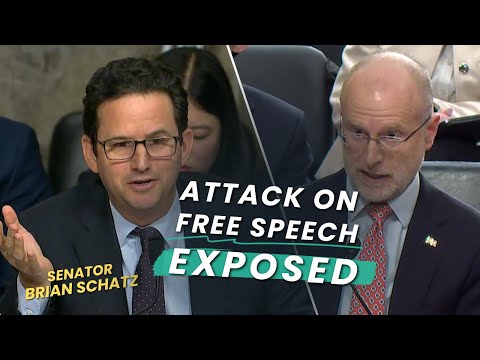
At a Senate committee hearing, a senator pressed Chairman Carr about whether the government — and specifically the Federal Communications Commission’s regulatory tools — could be used to police political satire or strip broadcasters of licenses.
The senator opened by saying "it is unbelievably dangerous for the government to put itself in the position of saying we're going to decide what speech we'd like and what we don't, and we're gonna threaten to take you off the air if we don't like what you're saying," and asked Carr for yes-or-no answers on whether the FCC had jurisdiction over satire under the public-interest and news-distortion standards.
Chairman Carr replied that the agency operates under a "public interest standard that Congress has put into the law," citing doctrines such as the "broadcast hoax rule" and the "news distortion rule." He said enforcement is guided by those specific rules and that Congress could change the statutory framework if it chose. "We have jurisdiction with respect to the broadcast airwaves uniquely to ensure that their operations are in the public interest," Carr said, but he also drew a line between ordinary satire and broadcast hoaxes or news distortion that would trigger enforcement.
When asked whether the FCC could revoke a license if it determined satire was not in the public interest, Carr distinguished his position: he said satire that is not a broadcast hoax or news distortion is "perfectly fine," and that his office was focused on applying the established public-interest rules rather than policing offensiveness. He added, "Licenses are not sacred cows," and acknowledged broadcasters can lose licenses for certain violations, but he stressed enforcement must follow legal standards.
The senator challenged earlier public characterizations that Carr had threatened to pull licenses over particular personalities, saying, "I am not doing that. I'm not going after Jimmy Kimmel." Carr denied that such threats had occurred and described some prior critiques as "projection and distortion." The exchange also touched on a past letter from Sen. Markey urging an investigation into Sinclair’s news activities; the senator clarified he had not signed that letter when Carr asked.
No formal actions, votes, or policy changes were recorded in the excerpted exchange. The discussion highlighted tensions over where the line between protected satire and actionable "news distortion" should be drawn and left open the possibility that Congress, not the agency, would decide any change to the statutory public-interest framework.