Get Full Government Meeting Transcripts, Videos, & Alerts Forever!
Get email alerts on the Counter Cartel Coalition topic
No spam. Unsubscribe anytime.
Trump announces "America's Counter Cartel Coalition," urges military action against cartels
Summary
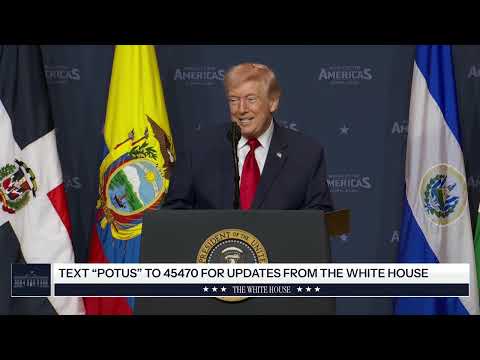
President Donald J. Trump announced the creation of the "America's Counter Cartel Coalition," saying representatives from 17 nations have joined and pledging a U.S.-led posture that may include lethal military force to target transnational cartels and their networks.
President Donald J. Trump announced the launch of the "America's Counter Cartel Coalition" at a summit of Western Hemisphere leaders, calling it a new military partnership to "eradicate the criminal cartels plaguing our region." He said representatives of 17 nations had entered the alliance and described the coalition's mission as using combined capabilities — including, he said, lethal military force — to dismantle cartel networks.
Trump framed the coalition as an "action coalition," not a forum for studies or white papers, and urged partner governments to share intelligence and precise locations of cartel operatives. "The heart of our agreement is a commitment to using lethal military force to destroy the sinister cartels and terrorist networks once and for all," he said.
The president said recent enforcement and interdiction efforts have reduced maritime smuggling and fentanyl flows, asserting that "drugs coming in through water is down 96 percent" and that fentanyl across the border is down 67 percent. He also characterized Mexico as "the epicenter of cartel violence" and said some partner countries may need to use their militaries in coordination with U.S. forces to confront heavily armed criminal groups.
Trump used his remarks to underscore a broader regional approach: he announced that the United States had formally recognized the Venezuelan government and described a newly struck "gold deal" to facilitate the sale of Venezuelan minerals and gold as an economic component of reengagement. He also said negotiations were underway with Cuban representatives and expressed optimism that a Cuba agreement "would be an easy one."
An administration official who spoke after the president described the coalition as a "force for good" that will bring U.S. leadership and partner capabilities together to "go on offense against the cartels," adding that the U.S. war department will work with participating countries and contribute intelligence and assets.
The president repeatedly tied the coalition to domestic border security, saying the U.S. had moved from a period of perceived porous borders to one of "a very strong border" under his administration. He also thanked summit organizers and several domestic and foreign officials for arranging the meeting and helping build the partnership.
What the announcement does not include, and what was not specified in the remarks, are details about the legal authorities, rules of engagement, target identification processes, command relationships among coalition members, or which countries will host or participate in armed operations. The president urged partners to "tell us where they are" and to cooperate on intelligence and operations, but he did not outline intergovernmental safeguards, oversight mechanisms, or timelines for specific joint actions.
The president said he would sign a proclamation formally launching the coalition and then yielded the floor to administration officials for brief remarks. No formal motion, vote, or timeline for next steps was given during the event.