Get AI Briefings, Transcripts & Alerts on Local & National Government Meetings — Forever.
Austin-Travis County EMS reports 100 sworn vacancies, expands auto-aid and whole-blood deployments
Loading...
Summary
ATCEMS told the Public Safety Commission it has roughly 100 sworn vacancies, plans expanded hiring and academies, is testing interagency auto-aid for March 2026 go-live, and reported more than 600 whole-blood units deployed to date and 668 opioid-related interventions year-to-date.
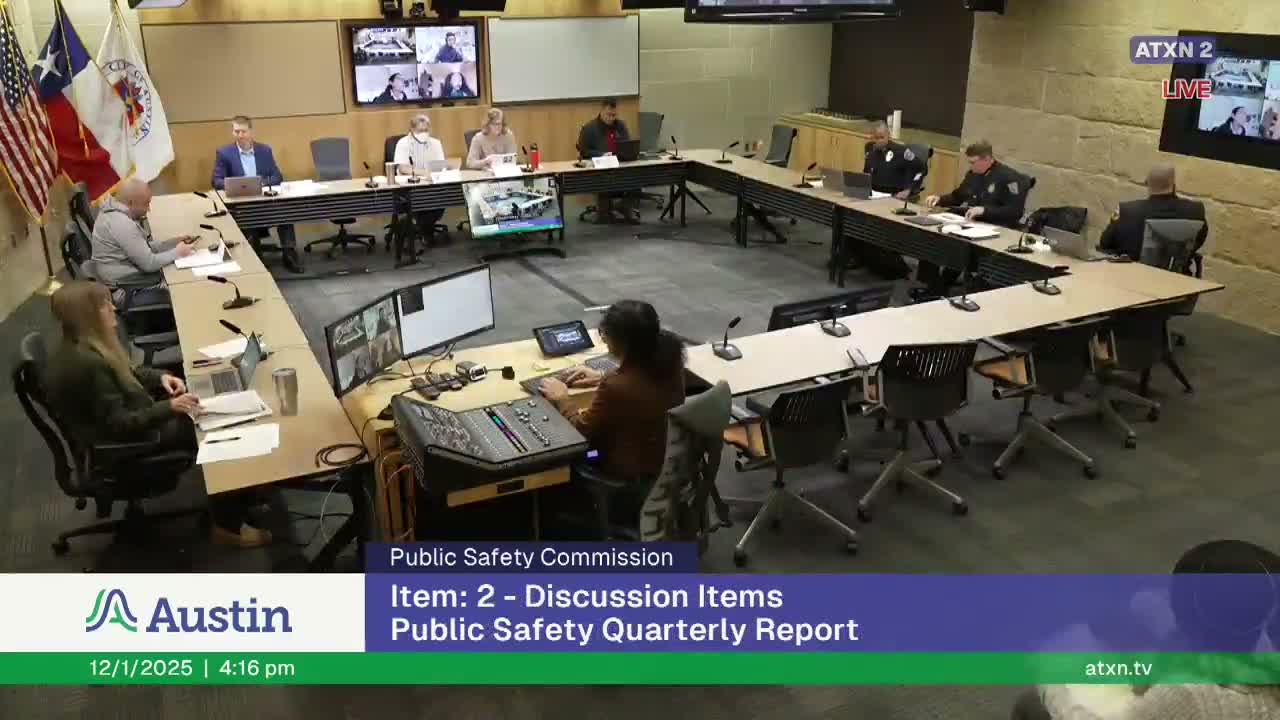
Austin-Travis County Emergency Medical Services told the Public Safety Commission on Dec. 1 that staffing shortages persist even as the department ramps recruiting and programmatic responses.
"That puts us at a sworn vacancy of 100," said Wes Hopkins, chief of staff for Austin-Travis County EMS, describing vacancies concentrated among entry-level medics and EMS clinical specialists. Hopkins said turnover is highest among medics with less than one year of service and that the department plans continued hiring, academy classes and a possible return to four academies to rebuild its pipeline.
Hopkins said the October hiring round produced 367 applicants, though not all met minimum qualifications; an academy class slated to graduate Dec. 17 at the Texas State Capitol will include 18 cadets. He noted ATCEMS achieved a 100% first-attempt pass rate for paramedic certification at a satellite facility—above state and national averages.
On opioid response, Hopkins reported 668 opioid-use-disorder interventions year-to-date, including 52 people connected to medication-assisted treatment in the most recent quarter; 44% of overdose alerts involved people experiencing homelessness.
Hopkins updated the commission on the EMS auto-aid project, which will dispatch the closest ambulance or a district commander to 911 calls across jurisdictional lines. Participating agencies include Austin-Travis County EMS, Williamson County EMS, two ESDs and Pflugerville and Lago Vista fire departments. Agency-specific policies and training are scheduled for December–January, with testing in February 2026 and a targeted March go-live, contingent on CAD/cloud interoperability.
On the whole-blood program, Hopkins said the department currently deploys whole blood from 12 street assets and has administered more than 600 units to date. "We have a less than 8% whole blood expiration without use," he said, crediting a rotation system with hospital partners. Hopkins added that whole blood is used for severe hemorrhagic shock, tactical and special-event response.
Commissioners asked technical questions about CAD integration for auto-aid, ultrasound availability across partner agencies, and whole-blood shelf life and rotation. Hopkins agreed to supply specific shelf-life details and noted district commanders in neighboring counties already carry whole blood.
The commission requested a follow-up standalone briefing on the whole-blood program and said it will schedule further budget and operational briefings in January as part of broader fiscal-year planning.