Get Full Government Meeting Transcripts, Videos, & Alerts Forever!
Get email alerts on the Growth Management topic
No spam. Unsubscribe anytime.
Carlsbad commission backs staff on growth management monitoring report, seeks MMLOS policy review
Summary
The Traffic Safety Mobility Commission voted to recommend that City Council receive and file the FY24–25 Growth Management Plan monitoring report and to pursue policy direction on an updated multimodal level-of-service (MMLOS) methodology, while commissioners pressed staff on exemptions and bicycle, pedestrian and transit facility priorities.
The Traffic Safety Mobility Commission voted to recommend that City Council receive and file the city’s FY24–25 Growth Management Plan monitoring report and to seek policy direction on a revised multimodal level-of-service methodology.
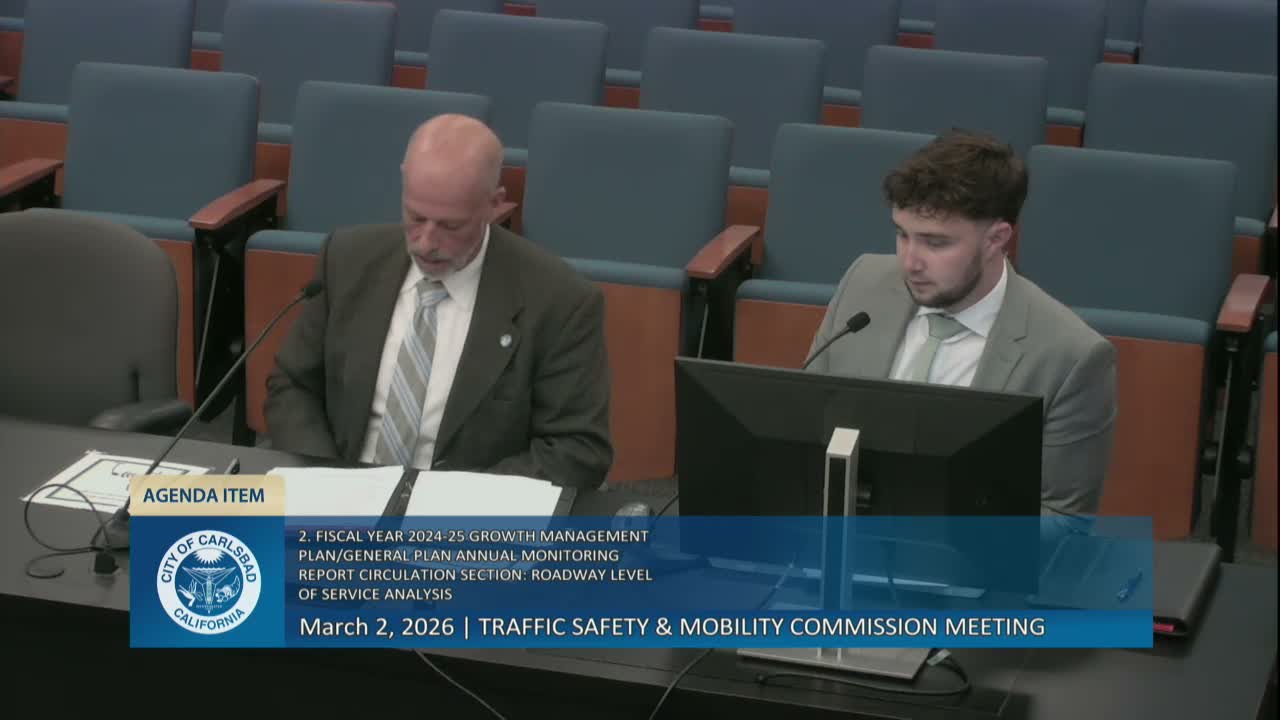
The commission’s action followed a staff presentation from Transportation Director and City Engineer Tom Frank and Associate Engineer Nick Gorham, who explained monitoring methods and recent results and highlighted how the city is balancing vehicle capacity with multimodal needs. Commissioner (S7) moved to support staff’s recommendation and Commissioner Cole (S3) seconded; the motion passed.
Why it matters: staff told the commission that state law changes—most notably SB 743’s shift from LOS to vehicle miles traveled (VMT) for CEQA—have changed how local jurisdictions evaluate transportation impacts. The monitoring report used automated counts at 79 locations across the city and identified eight deficient arterial segments and one deficient arterial connector; staff said those segments had been previously exempted and that exemptions remain a tool when right-of-way, environmental impacts or community values constrain improvements.
What staff presented: Gorham described the city’s monitoring methodology (three-day counts at 79 locations, peak-period comparison to capacity) and cited examples where analysis and council direction altered project scopes. On Cannon Road near Paseo Del Norte, staff added an eastbound right-turn treatment and narrowed travel lanes to create a 10-foot bike lane as part of an East–West corridor project. On College Boulevard, a December 2019 exemption and a later CIP (6028) were rescinded by City Council in June 2024 after monitoring showed acceptable operations; and on Melrose the council revised CIP 6034 to cap lane widths, preserve bike lanes and add a right‑turn overlap rather than widening.
Commissioner concerns and staff responses: commissioners pressed staff on the criteria for exemptions. Frank said an intersection or segment may be exempted when acquiring additional right-of-way is infeasible, when proposed improvements would cause unacceptable environmental or community-value impacts, or when a project would require more than three travel lanes in each direction. If an exemption is used, staff said it often triggers transportation demand management strategies in lieu of widening.
Pedestrian, bicycle and transit emphasis: Gorham walked the commission through MMLOS essential features — for pedestrians: sidewalk presence, width, ADA conformance and crossings; for bicycles: presence of bike facilities, MUTCD conformance and pavement condition; and for transit: stop amenities and access. Staff flagged CIP programs addressing gaps, including the citywide sidewalk construction program (CIP 6002), pavement management (CIP 6001), sidewalk repair (CIP 6013), ADA improvements (CIP 6049) and several El Camino Real widening segments (CIPs 6094, 6072, 6051).
Next steps: staff said the monitoring report and the recommendation to receive and file will go to City Council on March 10. Frank also said staff will bring the proposed MMLOS methodology to City Council for policy direction by September 2026, after which staff will return to the commission for additional input.
The vote: the commission’s motion to forward the report and support staff recommendations carried; the commission did not record individual roll-call tallies in the transcript.
Procedural note: HCD guidance was discussed during the presentation; staff summarized an HCD opinion that moratoria based solely on LOS thresholds are likely impermissible absent specific findings showing imminent threats to health and safety.