Get Full Government Meeting Transcripts, Videos, & Alerts Forever!
Get email alerts on the Homeless Services topic
No spam. Unsubscribe anytime.
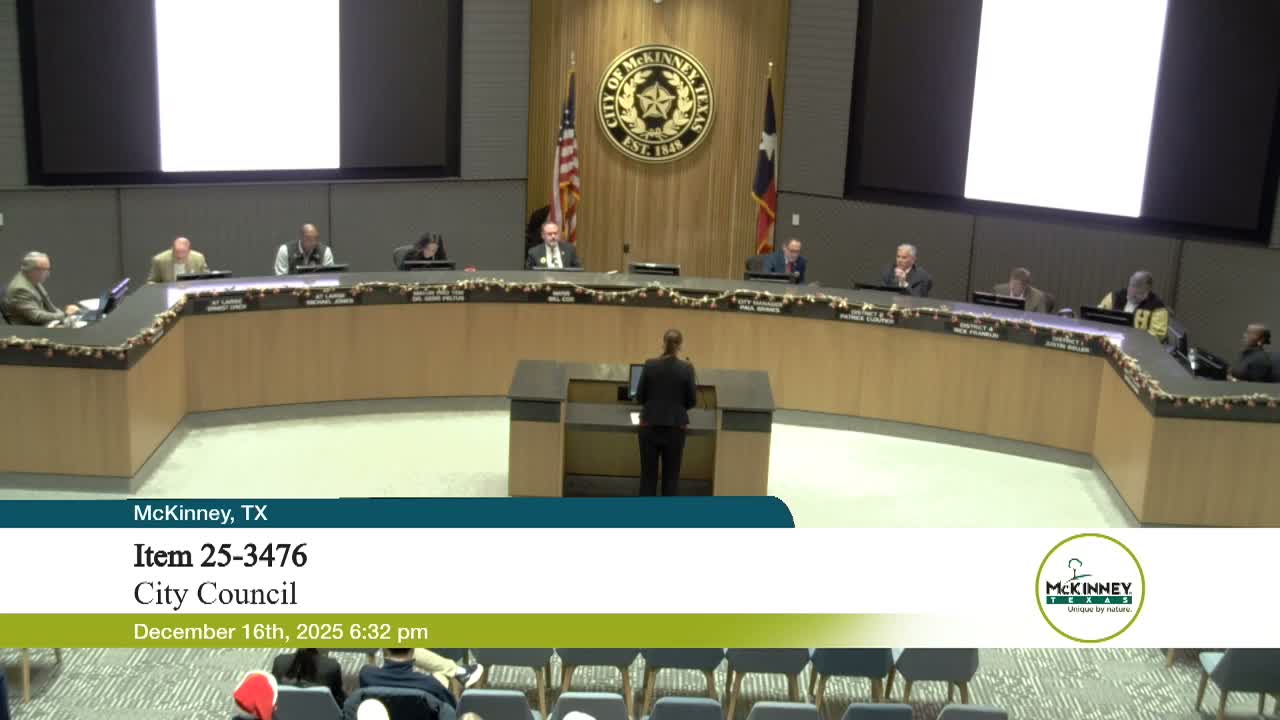
McKinney council allows First McKinney Baptist warming station to open at 40°F and serve up to 100 people
Summary
The council approved a variance to the city’s UDC allowing First McKinney Baptist Church to activate a warming station at an ambient temperature of 40°F and raise the maximum occupant load to 100; the measure passed 7–0 after staff presentation and public comment.
The McKinney City Council voted unanimously on Dec. 17 to grant First McKinney Baptist Church a variance to its temporary use permit to allow activation of an emergency warming station when ambient temperatures reach 40°F and to raise the facility’s maximum occupant load to 100.
Planning staff member Miss Arnold told the council the UDC default allows warming stations to activate when a forecasted ambient temperature drops below 32°F; the church’s prior variance allowed activation on a 39°F wind chill and an occupant limit of 75. “They are seeking approval to activate at 40 degrees ambient temperature,” Miss Arnold said, noting the requested threshold matches what the Salvation Army had in another local agreement and that staff cited National Weather Service and Centers for Disease Control data on hypothermia risk.
Miss Arnold said building inspections and fire staff reviewed life‑safety and restroom capacity concerns and that staff mailed 49 notification letters to neighboring property owners, receiving one supportive response.
Paul Ballesteros (speaker 1), who operates the church warming station, described eight years of operations, a bracelet system for guest management, checked bags, non‑police trained security, and examples of casework that included helping guests reach medical care or renew identification. “There’s no such thing as an insignificant life,” Ballesteros said.
A nearby homeowner, Travis Holfeld, said he opposed the change because of trash and loitering near his property across the street and asked council to consider neighborhood impacts.
Members discussed existing ordinances that affect downtown and broader approaches to sheltering people. One council member with medical experience said health outcomes worsen near 40°F and supported the variance on humanitarian and public‑health grounds.
Councilman Franklin moved to close the public hearing and approve staff’s recommendation; the motion was seconded and carried 7 in favor, 0 against. The variance will allow the church to activate earlier in cold weather and to accept up to 100 occupants when the warming station is operating.
What happens next: the city’s modified TUP will remain subject to building and fire inspections and to any operational conditions the council or staff imposes; staff said they would continue monitoring operations and code compliance.
Provenance: staff presentation SEG 570–624; public comments SEG 652–736 (operator) and SEG 751–789 (resident); motion and vote SEG 793–876.