Get Full Government Meeting Transcripts, Videos, & Alerts Forever!
Get email alerts on the Design Standards topic
No spam. Unsubscribe anytime.
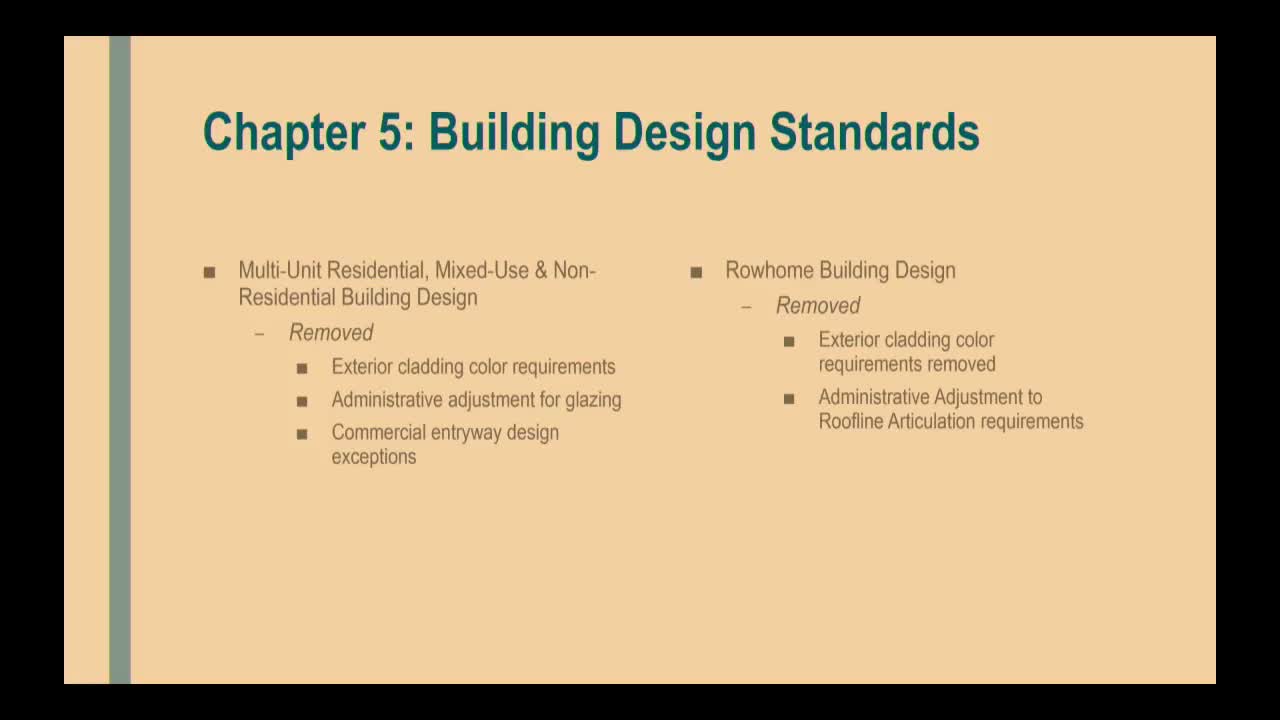
Commissioners debate aesthetics after consultants remove subjective color rules from draft code
Summary
Planning commissioners and consultants clashed over whether removing subjective cladding-color rules will permit buildings that meet objective standards but are considered 'ugly'; consultants said attorney advice removed color limits to avoid legal vulnerability and that PUDs and exceptions can preserve design oversight.
Planning commissioners questioned consultants on Feb. 11 after the draft zoning code removed cladding-color and similar subjective requirements, raising concerns that objective-only standards could allow buildings that are technically compliant but visually jarring.
One commissioner framed the tension bluntly: "Ugly's in the eye of the beholder," and asked how the code would prevent projects that meet material and dimensional rules from producing undesirable visual results. Consultants said the city attorney advised removing color rules because language tied to color is difficult to defend legally. They said the draft focuses on objective form and material standards and that traditional checks—planned unit development (PUD) review and planning-commission oversight for projects adjacent to residential areas—remain available to address aesthetics.
Several commissioners urged retaining review pathways that give the planning commission influence, not because good projects need heavy review but because the commission can guide marginal projects toward better outcomes. A planning-commission participant described three typical application types—excellent, mediocre and poor—and argued that the commission's role is to improve the middle group. Consultants and staff asked commissioners to consider applying objective standards more broadly and using PUDs or design-review processes where more discretionary review is desired.
Why it matters: The debate affects who decides what a community’s buildings look like—staff using objective checklists, a design-review board, or commissioners through discretionary review—and therefore shapes how future projects will fit with neighborhood character.
The meeting produced no change to the draft; staff said objective standards will allow staff approvals when requirements are met, while exceptions and PUDs will continue to come to the planning commission.