Get Full Government Meeting Transcripts, Videos, & Alerts Forever!
Get email alerts on the Universal Access Fund topic
No spam. Unsubscribe anytime.
Committee backs extending Georgia fund that helps keep landline service in rural areas
Summary
A Senate committee heard from legislators and industry that HB 998 would extend Georgia's Universal Access Fund through 2040, add statutory audit and reporting requirements, cap annual disbursements at $50 million and open limited participation to smaller "tier‑2" local exchange companies to preserve 911‑capable landline access in rural communities.
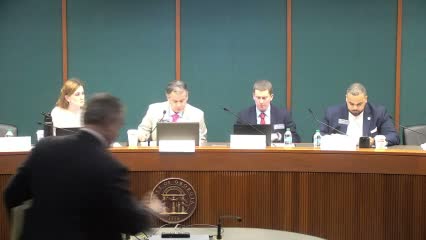
Representative C. Leverett presented House Bill 998 to the Senate Economic Development and Tourism Committee on March 10, describing changes to Georgia's Universal Access Fund to preserve basic telephone service in rural areas. "HB 998 will extend that period of disbursements through 12/31/2040," he told the committee, and said the bill also allows certain small "tier 2" exchange companies to opt into the fund by filing an election by August 1 if they meet size and service criteria.
The sponsor framed the fund as a carrier‑of‑last‑resort mechanism established by the General Assembly in 1995 to ensure telephone service where market forces would otherwise not provide it. He emphasized that reimbursements would be limited to the reasonable cost of providing landline voice service and not for cellular or unrelated products.
The bill would add three main guardrails: set an annual statutory disbursement cap at $50,000,000 (current dispersals are approximately $40,000,000 a year), codify the requirement that participating companies submit audits, and require the Public Service Commission to deliver a biennial report to the General Assembly on collections and disbursements.
Supporters and witnesses said the measure is driven by public‑safety and financing concerns. "So the term landline ... really means how the service is delivered and the service itself rather than the type of device," Rhonda Chatham, executive director of the GTBA, told the committee, arguing that landline service can be delivered over fiber and remains critical where cellular coverage is unreliable so residents can reach 911.
Members asked detailed technical and fiscal questions: committee members heard that 22 small companies exist in the state (21 members of the association plus one outside), that 19 currently participate in the program while three do not, and that aggregate reimbursements to participants totalled about $43,000,000 last year. Witnesses acknowledged the PSC currently holds detailed fund balances and said the bill's reporting requirement would increase public transparency.
Committee members stressed the public‑safety rationale, noting next‑generation 911 dependencies and the risk that, without the fund, small carriers could raise rates or withdraw service in sparsely populated areas. In light of those explanations, a senator moved that the committee give the bill a favorable report ("dupass"); the motion was seconded and the chair announced a unanimous voice vote.
The committee did not set implementation details beyond the statutory changes in the bill; the PSC will continue to oversee audits, collections and disbursements under the bill's approach. The committee recorded broad bipartisan support and moved the bill forward for further consideration.