Get AI Briefings, Transcripts & Alerts on Local & National Government Meetings — Forever.
Lawmakers hear testimony on bill to keep Working Connections Child Care eligibility at 60% of SMI, change payment rules
Loading...
Summary
Substitute House Bill 2,689 would keep WCCC income eligibility at 60% of state median income, set reimbursement rates at the 70th percentile, cancel a planned shift to enrollment-based payments, and alter attendance-based payment rules; witnesses debated implementation and survey response requirements.
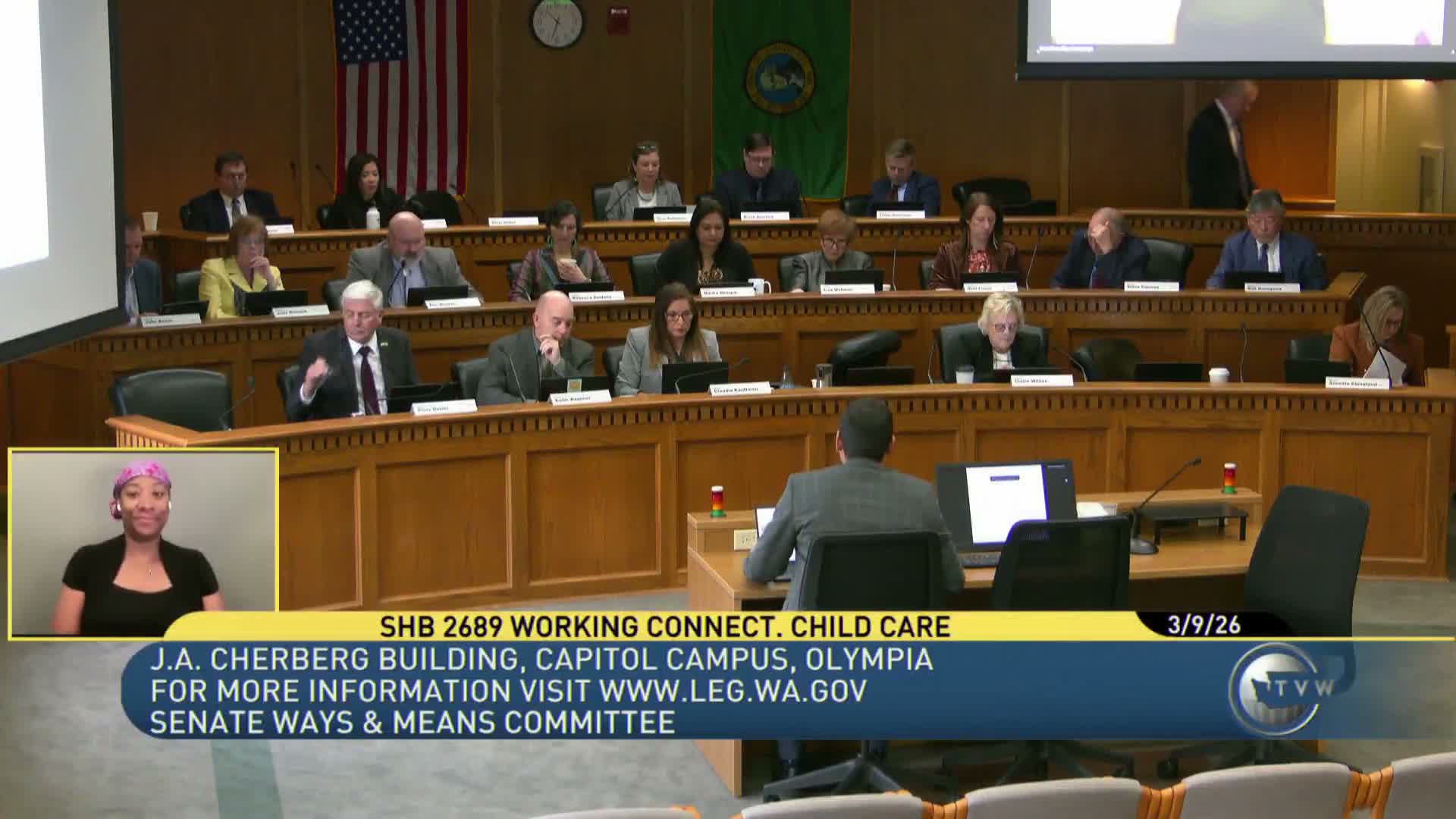
Substitute House Bill 2,689 drew testimony on March 9 as the committee considered changes to Washington's Working Connections Child Care (WCCC) subsidy program.
Josh Hinman, staff to the committee, summarized the bill's major provisions: it eliminates scheduled income expansions to 75% and 85% of the state median income, keeping eligibility at 60% of SMI; sets future subsidy rates at the 70th percentile of market (instead of the 80th); prohibits providers from receiving enhanced rates from a different region than their location for four specified counties; cancels the upcoming transition to enrollment-based prospective payment; modifies attendance-based reimbursement (full monthly payment if absent 10 days or fewer; half-month payment if absent more than 10 days but attends at least one day); and establishes a minimum provider response rate for market-rate surveys (65%) for a survey to be valid.
Hinman said a fiscal note estimates $103 million in savings in the 2025-27 biennium and $565 million over the four-year outlook, with implementation and administrative costs for DCYF also noted.
Witnesses expressed mixed views on specific provisions. Erin Hike of SEIU 95 supported the bill generally but said applying the 65% response-rate metric to the 2026 market-rate survey would "change the rules of the game" because that survey is already closed; the union and others asked the committee to adopt an amendment to address timing. Katie Warren of the Washington State Association of Head Start and ECAP favored the House approach to attendance payments as simpler and urged a 40% response-rate floor with continuous improvement requirements as an alternative to the 65% threshold.
Proponents and providers said the substitute bill's attendance and payment provisions are intended to simplify billing and reduce provider administrative burden; critics warned that rapid changes in attendance policy could increase audits and overpayment disputes.
The committee closed public testimony on HB 2,689 and moved on to the next bill without a final vote.