Get Full Government Meeting Transcripts, Videos, & Alerts Forever!
Get email alerts on the Land Use Pud Rezoning topic
No spam. Unsubscribe anytime.
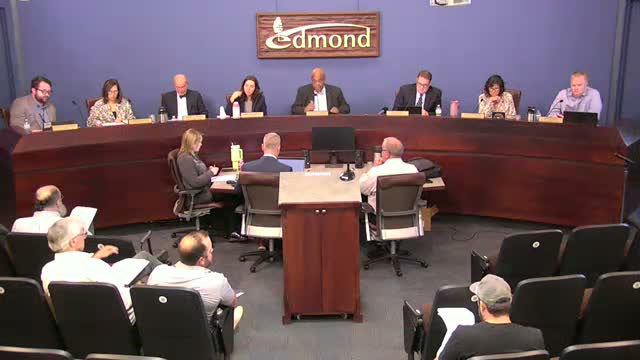
Edmond council pauses controversial East Fork PUD rezoning after residents raise traffic, flood and density worries
Summary
At its Sept. 23 meeting, the Edmond City Council continued consideration of the East Fork Planned Unit Development (Z24-00003) to Oct. 14 after residents raised concerns about traffic, flooding and lot density; the developer offered to reduce units and officials pledged further outreach.
Edmond — The City Council on Sept. 23 continued a contested rezoning request for the East Fork Plan Unit Development (Z24-00003) after more than two hours of staff presentation, developer remarks and lengthy public comment that focused on traffic, flood risk and proposed lot density.
Planning staff opened the public hearing by describing the site as roughly 150 acres southwest of Coffee Creek Road and Air Depot and said the PUD divides the site into four 'tracks' with a variety of allowed uses. Staff said Tracks 1 and 2 together could include up to 120 dwelling units, Track 3 would permit single-family detached housing with minimum lots of 3,600 square feet and a maximum of 569 houses, and approximately 60 acres of the site are in floodplain. Planning staff recommended approval (the Planning Commission had voted 3–0 in favor at its Sept. 3 hearing).
Residents told council the proposal is out of scale with nearby neighborhoods and raised repeated concerns about traffic on two-lane Coffee Creek and Air Depot roads, school capacity, and flood-prone areas. "This PUD proposal is not in alignment with the surrounding areas," said Bill Thompson, who said he lives north of the proposed development and described the small lot sizes and lack of on-site recreation as incompatible with the neighborhood.
A number of neighbors provided calculations and examples. Dr. Charles Brecke said the PUD as shown could add about 689 dwellings (569 single-family plus roughly 120 multifamily/other units), which he estimated would translate to roughly 1,860 additional residents and about 1,450 new cars in the morning peak alone, a figure he said would overwhelm local two-lane intersections.
Developer David Lambeth acknowledged concerns and described outreach efforts, telling council he had met with landowners and residents and had offered to reduce density. "I offered them a 100 units off," Lambeth said, adding he was willing to continue discussions and that the plan included tree preservation (he said the project preserves about 45% of tree cover) and areas intended for trails and passive recreation. Planning and developer representatives also discussed the opportunity to grant right-of-way if ODOT later needs land for an interchange.
Council members and staff asked for more concrete commitments and emphasized that rezoning is only one of several approvals: site plans, plats and engineering reviews will follow if rezoning is approved. Councilmembers pressed for more community outreach and for clearer limits or ranges to be documented before a final vote. "This is zoning — it's not set in stone — but we can ask for a little bit more concreteness," one councilmember said.
After public comment and council discussion, a motion to continue consideration of Z24-00003 to the Oct. 14 council meeting — with the applicant and residents directed to meet for further dialogue in the intervening weeks — passed. The continuation gives staff and the developer time to report back with clarifications on school and traffic analyses, stormwater and drainage plans, tree preservation/conservation-easement options and any revised unit counts.
If the application returns, subsequent steps will include site-plan and plat reviews before planning and engineering; those later approvals will be the venues for more detailed drainage, traffic mitigation and design conditions.
What happens next: The council set a continuance to Oct. 14 and asked staff to help coordinate further meetings between the applicant and adjacent landowners; council members said they expect additional information on traffic, drainage and potential right-of-way implications from ODOT prior to any final decision.