Get AI Briefings, Transcripts & Alerts on Local & National Government Meetings — Forever.
Court of Appeals hears argument in State v. Heckman over late discovery and silence inference
Summary
At oral argument in State v. Heckman (Ct. App. No. 405711), the defense urged dismissal or a mistrial after a supplemental detective report was disclosed after opening statements; the state said it suppressed the report and that tailored questioning avoided a Fifth Amendment violation. The panel recessed without ruling.
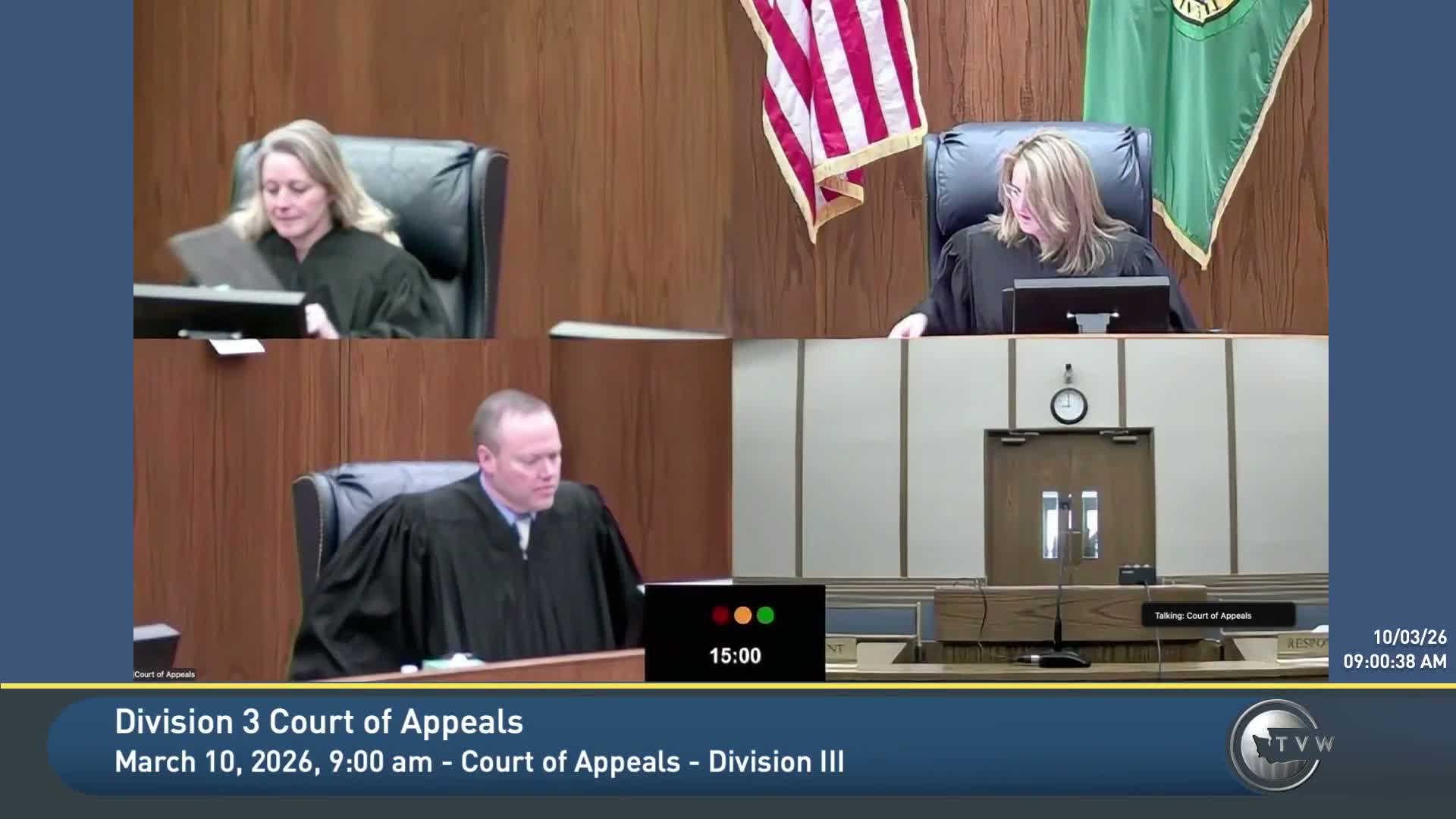
The Washington Court of Appeals, Division 3, heard oral argument in State v. Heckman, Court of Appeals No. 405711, where defense counsel urged reversal after the state provided a supplemental detective's report to the defense after jury selection and opening statements.
Appellant's counsel Laura Chuang told the court the late disclosure prejudiced defense preparation and created an ethical dilemma for trial counsel about whether to put the defendant on the stand. "This discovery shows that he had," Chuang said while summarizing the trial record, arguing the timing forced defense counsel into a choice between presenting testimony and avoiding eliciting statements the attorney believed might be inconsistent with new material the defense had not seen earlier.
Why it matters: Chuang argued the trial court abused its discretion under the relevant court rules by denying a motion to dismiss or, at minimum, by not declaring a mistrial. She told the panel the late report came after a multi-year pendency and that a Speedy Trial deadline set to expire roughly a month after trial made meaningful rescheduling impractical.
State counsel Ryan Ballas acknowledged the late disclosure and said the state moved promptly to remedy it. "We agreed to suppress it," Ballas told the panel, arguing suppression was an appropriately tailored remedy and that dismissal was an extraordinary measure not warranted by the circumstances. On the Fifth Amendment question, Ballas said the prosecutor's permitted question'whether the detective had attempted to contact the defendant'focused on investigative steps, not on whether the defendant had remained silent, and was therefore narrowly tailored to avoid creating an impermissible inference.
Panel questioning focused on two discrete legal questions: whether the late disclosure caused prejudice sufficient to require dismissal or mistrial, and whether the detective's testimony and the prosecutor's line of questioning created an improper inference of silence under State v. Romero. Ballas argued the trial court's remedies (including suppression) and the fact pattern did not amount to an abuse of discretion and urged the court to affirm.
The record cited at argument included the trial judge's handling of a motion in limine related to questioning and defense counsel's contemporaneous remarks indicating concern about an "ethical dilemma." Counsel and the panel also discussed the balancing of probative value versus prejudice when allowing testimony about investigators' attempts to contact the defendant.
The court recessed after oral argument and did not announce a ruling from the bench. The panel took the matter under advisement.