Lifetime Citizen Portal Access — AI Briefings, Alerts & Unlimited Follows
City staff: Manual Branch bacteria levels elevated but stable; $6 million USDA grant to fund debris removal and bank stabilization
Loading...
Summary
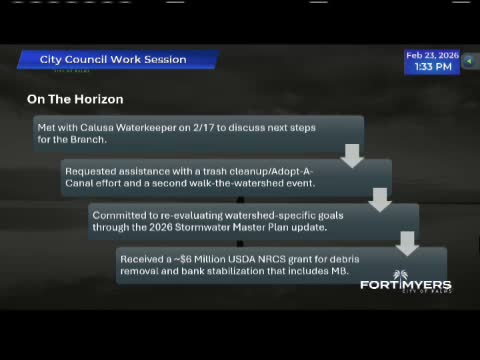
City environmental staff told the council that Manual Branch shows elevated but stable bacteria levels with no recent human-source markers and recommended nonpoint‑source remedies. The city received a $6 million USDA NRCS grant aimed at debris removal, bank stabilization, dredging and flow restoration, with construction targeted in 2026.
City environmental staff told the Fort Myers City Council on Wednesday that long‑running sampling at Manual Branch shows elevated but steady bacteria concentrations, and that recent microbial source‑tracking did not find evidence of an ongoing human sewage source.
Justin Mahone, the city’s environmental compliance manager, said the branch’s bacterial counts have been ‘‘elevated but stable’’ and that testing for human indicators such as acetaminophen and human DNA markers produced non‑detects in recent quarters. ‘‘That tells us there’s likely no smoking‑gun point source or lift station dumping directly into the creek,’’ Mahone said.
The presentation emphasized first‑flush spikes — very high counts immediately after heavy rain — as indicative of nonpoint sources such as stormwater runoff, trash and pet waste. Mahone said the city’s monthly surveys still find trash and pet waste in the channel and that some infrastructure (private collection systems and lift stations) lies in other jurisdictions or on private property, limiting city access for diagnostic testing.
Why it matters: Manual Branch feeds into the Caloosahatchee River; repeated high counts can affect downstream water quality and public perception. Staff said improvements will take time because bacteria can persist in sediment and low‑flow areas and because jurisdictional and funding constraints complicate rapid fixes.
Grant, scope and schedule: Mahone told the council the city has executed a $6,000,000 grant from the U.S. Department of Agriculture Natural Resources Conservation Service (NRCS) to fund debris removal, bank stabilization, vegetation trimming to increase sunlight exposure, demucking of substrate, and flow‑restoration work across seven connected water bodies including Manual Branch. The grant was executed in April 2025; staff said the procurement reissue was expected in early 2026 with a target notice‑to‑proceed in April 2026 and project completion in November 2026.
What staff will do next: The city plans additional flow monitoring tied to a $60 million, 10‑year SSES (sanitary sewer evaluation study) project, continued monthly sampling, collaboration with the Waterkeeper organization for additional field work, and an updated watershed plan as part of the 2026 stormwater master plan update.
Council reaction: Councilmembers asked whether nearby properties (a trailer park and the hospital) contributed to contamination and were told legacy stormwater infrastructure and large paved areas can increase runoff but that the city’s MST results point away from direct human sewage as a continuing source. Councilmembers pressed for continued community outreach and stronger interagency coordination.
The city framed the remediation as a combination of infrastructure, trash removal and continued monitoring, not an immediate regulatory enforcement action. The council did not take a vote; staff sought direction and answered questions about procurement and partnership steps.