Lifetime Citizen Portal Access — AI Briefings, Alerts & Unlimited Follows
City says Manual Branch bacteria levels appear driven by legacy and natural sources, not a steady sewage source
Loading...
Summary
City staff and consultants reported monthly sampling shows elevated but stable E. coli in Manual Branch; HF183 (human DNA) and acetaminophen tests have trended to non-detects, prompting the city to continue targeted monitoring, infrastructure investigations and public outreach rather than immediate major dredging.
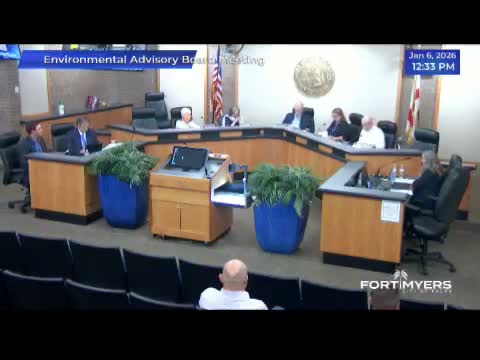
The Fort Myers Environmental Advisory Board heard a detailed update on water-quality monitoring and remediation work in the Manual Branch watershed on Jan. 6, with city staff saying results point to legacy or natural sources rather than an ongoing human sewage source.
Justin Mahone, the citys environmental compliance manager, told the board the city developed a Pollution Reduction Plan in 2021 after a large sewer spill in 2020, and that the plan remains the guiding document. "HF183 and acetaminophen have been non-detected in recent quarters," Mahone said, describing those results as the evidence that persistent elevated bacteria levels are likely attributable to natural or legacy sources rather than a continual human point source.
GHD project manager Jenna Martin walked the board through sampling methods, laboratory protocols and action-trigger levels used to evaluate E. coli and human-waste indicators. Martin said field samples are hand-delivered under chain of custody and that microbial-source-tracing uses the HF183 DNA marker and acetaminophen as complementary human-waste indicators. "If a sample falls in the highest trigger categories, we resample immediately and perform additional delineation testing to try to locate a hotspot," she said.
City staff and the consultant reported that most spikes have not sustained through resampling and that delineation work, windshield surveys and additional targeted sampling have not revealed a continuous sanitary-sewer overflow (SSO) feeding the branch. The presenters pointed to several contributing, nonpoint factors: dense vegetation that reduces UV exposure, trash that impedes flow and creates stagnant conditions, wildlife and pet waste, and intermittent illicit connections or recent directional-drilling breaches. Mahone said the city has remediated a directional-drill connection discovered near a lift station and continues routine lift-station inspections through SCADA monitoring.
Board members pressed staff on differences between volunteer sampling (for example, the Calusa Waterkeeper) and city monitoring; staff said E. coli is the appropriate indicator for freshwater segments and explained the citys monthly MS4 sampling schedule. In response to public concerns, Mahone emphasized the citys ongoing commitment to voluntary monitoring beyond mandatory MS4 sampling, and described plans to pursue grants, continue walk-the-watershed exercises and explore stormwater retrofits and green infrastructure in the upcoming stormwater master plan update.
Public commenters asked the board to take a systems approach, urged independent third-party testing, and warned against heavy-handed removal of canopy vegetation without certified arborist oversight. "This is an ecosystem management problem," Jennifer Hagen, a resident whose backyard is adjacent to Manual Branch, said during public comment. "Vegetation does help filter some pollutants; clearing it is not a total solution."
The board moved unanimously to recommend that the city submit quarterly monitoring reports to City Council to improve public access to the data. Staff said the city will continue monthly field sampling, keep the reporting dashboard current and pursue grant funding and targeted projects where feasible.
The update concluded with staff noting the long-term nature of remediation: demucking and large-scale removal of legacy substrate is costly, jurisdictionally complex and likely requires grant funding and multiagency coordination. Mahone provided an estimate for demucking and disposal of the creeks muck of about $1.8 million to cover roughly 2.5 miles of the channel, and said the city is prioritizing lower-cost, high-impact tactics such as trash abatement and community engagement.