Get AI Briefings, Transcripts & Alerts on Local & National Government Meetings — Forever.
DFA presents governor's balanced budget: $122M boost for EFAs, $200M in Medicaid set‑asides and tax‑cut priorities
Loading...
Summary
DFA officials presented a roughly 3% RSA increase in the governor's balanced budget, proposing $122 million added to Education Finance Allocations, a $70 million one‑time contingency, an additional $100 million for Medicaid sustainability (bringing set‑asides to $200M), and an emphasis on prioritizing tax cuts. Committee members pressed DFA on costs and timing.
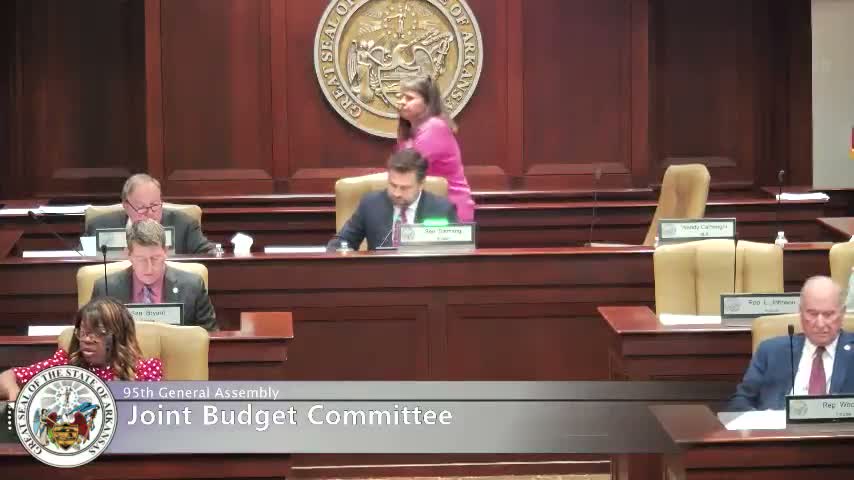
The Department of Finance and Administration presented the governor's balanced budget proposal and answered members' questions on its key numbers and priorities.
DFA officials described a proposed 3% year‑over‑year increase in the Revenue Stabilization Allocation (RSA) and identified funding priorities the governor asked them to build into the proposal, including reducing growth in state government spending, further tax cuts and continuing progress on structural income tax reductions. "When the governor was instructing us to begin building the proposed budget, she was focused on holding down growth in state government and prioritizing tax cuts," DFA staff said.
The package adds $122 million to the EFA (Education Finance Allocation) RSA line for FY27 and includes a $70 million contingency set aside from FY26 surplus that would be used as a one‑time fund for EFAs if needed. DFA said the $122 million reflects incorporating one‑time monies transferred in FY26 and that any one‑time usage in FY27 would be rolled into the RSA for FY28.
DFA also proposed an additional $100 million for Medicaid sustainability on top of an existing $100 million set aside, for a total of $200 million available to stabilize the Medicaid trust fund in FY27. "We'd have a total of $200,000,000 in set asides available to go into the Medicaid trust fund in FY27," the presenter said, and added that staff did not expect spending from that new set aside in FY26.
Members pressed DFA on the cost of proposed income tax cuts. DFA said including the pass‑through entity tax, each one‑tenth of a percentage point cut in income tax reduces revenue by about $58 million. "So generally for each tenth of a percent in reducing income taxes ... it's about $58,000,000 per tenth," Mr. Hudson said in response to a member asking the FY27 cost of a 0.5% cut.
Committee members also questioned whether the RSA additions included new money for public education. DFA clarified that the adequacy fund distribution (public K–12 adequacy) is funded primarily from sales tax flows and the productivity trust for schools; the EFA additions discussed in the RSA are intended to align funding for Education Finance Allocations and related programs rather than create a separate new adequacy stream for K–12 outside the mechanisms identified.
DFA listed additional targeted monies in the presentation: $6 million for higher education through the productivity formula, $7 million for drug task forces, $5 million for the Department of Corrections medical contract, $6 million for the governor's faith‑community initiative ("10:33"), and $5 million to the inspector general to address SNAP error rates. DFA said work on SNAP error‑rate reductions would involve collaboration with DHS.
The presentation drew follow‑up requests from members for further modeling, including exact dollar impacts of proposed tax cuts, timing of Medicaid trust inflows, and how contingency set‑asides would be deployed. DFA encouraged members to review the materials and meet with governor's staff before session.
The committee took no final action on the budget presentation itself at the meeting; members carried several procedural letters and appropriations requests related to institutions during the hearing and were advised they would have time to digest and revisit the proposal in session.