Lifetime Citizen Portal Access — AI Briefings, Alerts & Unlimited Follows
Senate energy committee reports House Bill 4012 to full Senate after counsel outlines shorter PSC timelines
Loading...
Summary
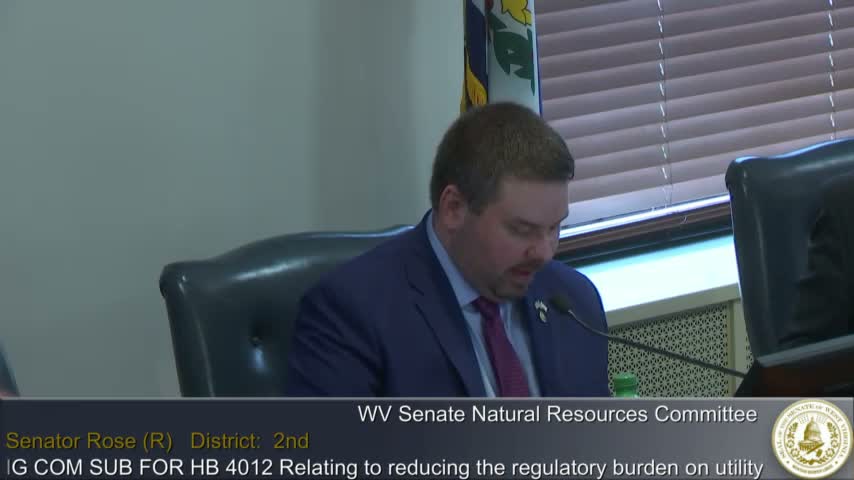
The Senate Energy, Industry and Mining Committee voted to report an engrossed committee substitute for House Bill 4012 to the full Senate without recommendation. Committee counsel said the bill shortens several Public Service Commission review timelines and adds requirements for large transmission projects and certificate applications.
At a meeting of the Senate Energy, Industry and Mining Committee, members voted to report an engrossed committee substitute for House Bill 4012 to the full Senate without recommendation and refer it to the Senates committee on energy industry and mining.
Committee counsel told the panel the bill would reduce the Public Service Commissions decision timeline on certificates of public convenience and necessity by 30 days (for the category read in the transcript, from 270 days to 240 days) and shorten final submission periods from 90 to 60 days. Counsel also said the measure sets shorter deadlines for projects at different cost thresholds: for water or sewer projects under $10,000,000, final decisions would be due in 190 days (down from 225), and for projects costing more than $100,000,000, the final decision timeline would fall from 400 to 360 days with final submissions reduced to 60 days.
Why it matters: The bill would compress review schedules for the Public Service Commission, alter procedural deadlines for applicants and could limit the commissions timeline for weighing alternatives and public comments on utility and transmission projects.
Committee counsel said applicants would be required to include a statement justifying the need for a facility and an examination of alternatives, "including without limitation, advanced transmission technologies," and that the commission may consider the costs and economic feasibility of those technologies when evaluating projects. Counsel also said the bill would bar the commission from granting a certificate for an electric transmission line of 200 kilovolts or greater unless the applicant demonstrates by "clear and convincing evidence" that the costs allocated to West Virginia load-serving entities are roughly commensurate with benefits to West Virginia ratepayers. Counsel added that applicants must commit to design and construct off-take facilities necessary to serve West Virginia retail load at the applicants expense and that failure to meet those commitments could be grounds for denial.
On procedural points, counsel said a public utility may not begin maintenance or repair work until it receives a certificate of public convenience and necessity, though the commission could waive that requirement in its discretion. Counsel also said the time frame for commission siting decisions would be reduced from 300 days to 270 days.
Vice Chair moved the motion to report the bill to the full Senate without recommendation. Chair William called for a voice vote; members said "aye," the chair declared the motion adopted and ordered the bill reported to the full Senate. The committee adjourned afterward.
Next steps: The engrossed committee substitute for House Bill 4012 will be transmitted to the full Senate for consideration.