Lifetime Citizen Portal Access — AI Briefings, Alerts & Unlimited Follows
Oregon House passes bills on housing preservation, Planned Parenthood funding, farm stores and AI safeguards
Loading...
Summary
The House passed a package of measures March 4, 2026, including a housing preservation fund, a state reimbursement and contingency program to replace certain Medicaid payments to Planned Parenthood, a new farm-store permitting pathway, clarifications to public meetings law, and safeguards for AI chat systems used by minors.
The Oregon House spent its March 4 floor session clearing a wide range of measures, approving bills to preserve at-risk affordable housing, create a state reimbursement mechanism for Planned Parenthood services affected by federal changes, expand farm-store and agritourism rules, tighten public meetings definitions, and require safety checks for AI chat systems used by young people.
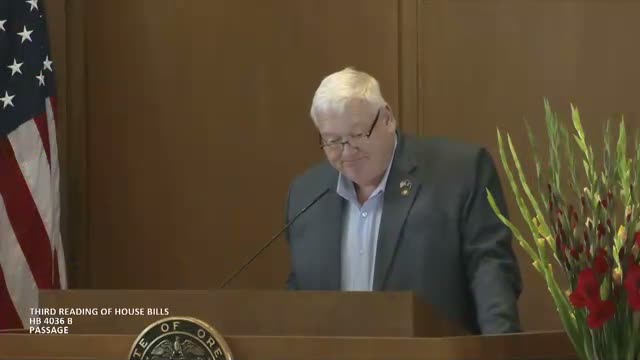
Representative Marsh moved concurrence and the House repassed a number of bills the Senate had amended, while the chamber also took final passage votes on bills that came up for third reading. On housing, lawmakers approved House Bill 4036 to establish the Housing Opportunity, Longevity and Durability (HOLD) Fund to preserve existing affordable units at risk of losing affordability. Representative Marsh said the measure "establishes the Housing Opportunity, Longevity and Durability Fund ' to preserve affordable housing, including manufactured housing parks that are at risk" and noted an initial program administration allocation included in the bill.
Health-care access and federal funding shifts drew the most sustained debate. Representative Bowman, sponsor of House Bill 4127, said the measure is aimed at maintaining preventive and primary care if federal changes block Medicaid reimbursements to certain providers. "This bill has nothing to do with funding abortion," Bowman said, arguing it would preserve cancer screenings, birth control, STI testing and other services. Opponents framed the proposal as a special backfill for a single organization. Representative Juncker said the bill "singles out 1 organization and guarantees a special taxpayer backfill," and urged a no vote. The House approved HB 4127 on final passage.
Agriculture and land-use policy also took center stage. House Bill 4153 A, carried by Representative Breeze Iverson, creates a statutory pathway for "farm stores" and clarifies agritourism activities, limits farm-store size, and preserves county authority on traffic and sanitation. Supporters said the change helps farms diversify revenue and keep land in production; opponents warned it could enable large-scale commercialization of farmland. After extended floor debate and questions about siting limits and tax deferral mechanics, the bill passed.
Other bills moving through the day included HB 4016 (tax compliance checks for large state contracts), HB 4084 (economic development and permitting reforms), and HB 4128 (restrictions on certain institutional investors buying single-family homes). On government transparency, House Bill 4177 clarified the statutory meaning of "deliberation" under Oregon's public meetings law, tightened rules against serial deliberations using intermediaries, and shifted responsibility for purely administrative violations to the public body rather than individual members; Representative Sosa urged an aye vote and the House passed the bill.
On technology and youth safety, the House approved Senate Bill 1546 to require AI chatbot operators to disclose that responses are generated by AI, implement evidence-based systems to detect self-harm risk, prohibit outputs that promote self-harm, and add extra protections and break reminders for minors. Representative Dobson described the bill as an effort to "ensure our kids are safe when they use this new technology," and the measure cleared the floor.
Votes at a glance
- HB 4036 (HOLD Fund for affordable housing): passed (final passage) - HB 4127 (state reimbursement/contingency funding for certain Medicaid-provided services): passed (final passage) - HB 4153 A (farm stores/ agritourism permitting pathway): passed (final passage) - HB 4016 (tax compliance for state contractors): passed (final passage) - HB 4084 (economic development/permitting): passed (final passage) - HB 4128 (controls on institutional investor purchases of single-family residences): passed (repassed with Senate amendments) - HB 4177 (public meetings law clarifications): passed (final passage) - SB 1546 (AI chat safeguards for minors): passed (final passage)
What's next: Several passed bills were sent back to the Senate as required; the House recessed and scheduled reconvening and additional votes later in the week. Members who raised objections or asked for further work signaled that some bills' provisions could be revisited in future sessions or implementation rulemaking.
Quotes and attributions in this story come from floor remarks and motions recorded by the House clerk and attributed to the named representatives on the record. The article refrains from drawing conclusions beyond what speakers stated on the floor.
Ending: The House recessed for the day after completing its order of business and will reconvene at the time scheduled by leadership.