
House Finance hears SB 146 to broaden REAA Fund for Mount Edgecumbe; committee sets bill aside pending committee substitute
Get AI-powered insights, summaries, and transcripts
Sign Up Free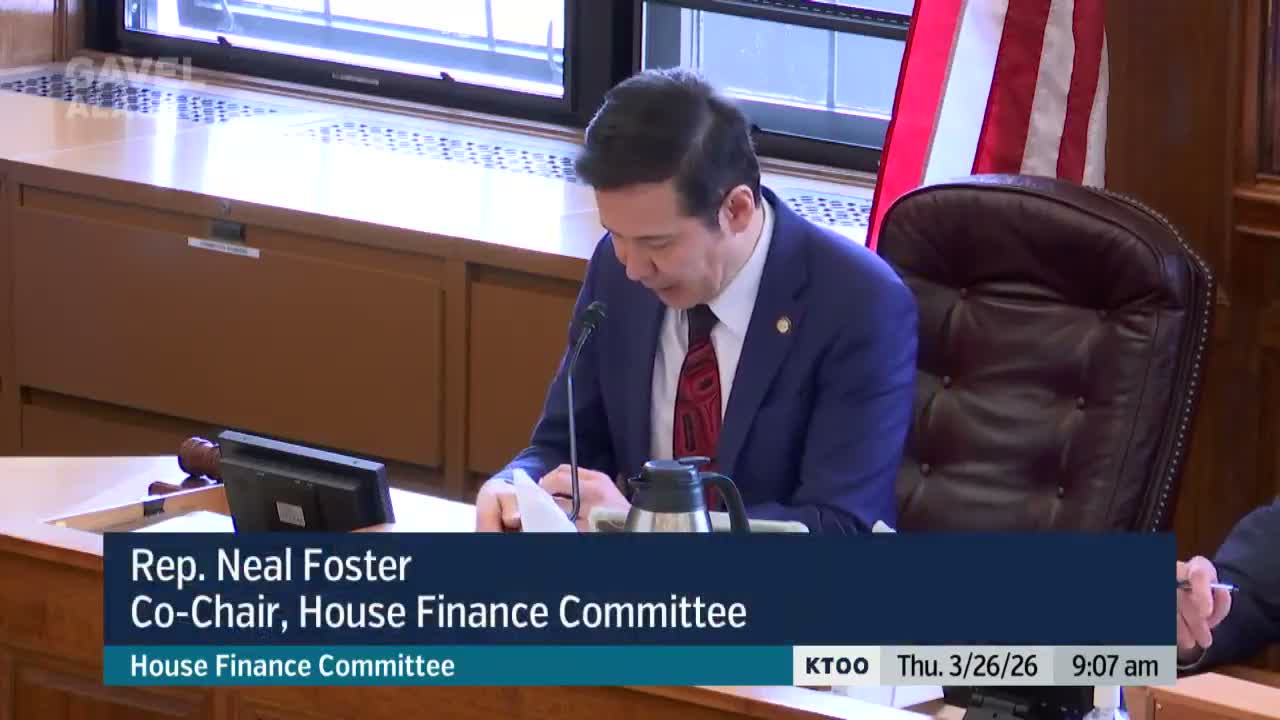
Summary
The House Finance Committee heard Senate Bill 146, which would amend the REAA Fund to permit major maintenance and construction at Mount Edgecumbe High School and (initially) major maintenance for teacher housing and would remove a $70 million statutory cap. Committee members questioned multiple fiscal‑note versions and staffing capacity and set the bill aside pending a committee substitute.
Juneau — The House Finance Committee held a first hearing on Senate Bill 146 on March 26, a measure that would change how the regional education attendance area (REAA) fund can be used for Mount Edgecumbe High School and, in its original form, for teacher housing statewide.
Representative Robin Neill Freer, the bill presenter, told the committee the measure would amend REAA Fund language to include major maintenance and construction at Mount Edgecumbe High School and initially would allow major maintenance for teacher housing; the bill would also remove a $70,000,000 cap that now causes any fund balance above that amount to lapse to the general fund. “Senate Bill 146 amends REAA Fund language to include both major maintenance and construction at Mount Edgecumbe High School and major maintenance for teacher housing,” Freer said.
The sponsor said he worked with the Senate Finance co‑chairs and the governor’s office on a committee substitute (CS) that would remove the teacher‑housing maintenance language from the bill. “I still believe that maintaining rural teacher housing is important and necessary,” Freer said, “and I still believe that the state of Alaska should have a role in that maintenance, but I hope that removing this language from Senate Bill 146 is taken as a good show of faith to the governor, that we can avoid another veto of this bill.”
The Department of Education and Early Development (DEED) presented a fiscal note. Heather Heineken, DEED’s director of finance and support services, summarized staff and one‑time costs included in the department’s version and said the DEED document she accessed showed FY‑26 costs of roughly $313,300 and out‑year costs near $297,300, reflecting the addition of two positions and inspection travel. “The total cost for would have been FY ’26 would be $313,300,” Heineken told the committee.
Committee staff and members identified multiple fiscal‑note versions on the record and on the committee portal. Bridal Anderson, staff to Co‑Chair Foster, said the committee’s current fiscal note in the packet carried control code GKLQT and represented the updated fiscal estimate; Anderson told the committee that the department reading earlier had been an outdated fiscal note from last year. Anderson stated on the record that the most current note in the packet listed a FY‑27 operating total and two full‑time positions. At different points during the hearing members and staff cited totals of $552,300, $352,300 and the departmental figure Heineken read earlier, reflecting inconsistent versions available to participants.
Heineken also explained capacity constraints at DEED’s facilities section. She said the section had two school finance specialists and one building management specialist on staff, that three positions had become vacant since the previous November and two vacancies remained in recruitment, and that the department lacked in‑house residential‑housing expertise required to prepare and rank CIP applications for a boarding school like Mount Edgecumbe. “We do not have any expertise in residential housing,” Heineken said, noting the bill as drafted would likely require a dedicated building management specialist to avoid a conflict in the CIP ranking process.
Members pressed statutory and eligibility issues. Representative Galvin asked whether the REAA fund already permitted major maintenance; Heineken pointed to statute 14.11.030 and said the primary function of the fund is school construction and that Mount Edgecumbe is not, under current statute, defined as an REAA school and thus is not eligible for the fund absent statutory change. “The last line in that statute is the primary function of the fund is to fund school construction projects,” Heineken told the committee.
Several members recounted site visits and expressed urgency about Mount Edgecumbe’s condition. Freer described visiting in February and said he observed significant deferred maintenance in dormitories and other facilities; Representative Hannon recounted his first teaching assignment at Mount Edgecumbe and said some dorms predate state takeover, arguing the committee has a responsibility to address living conditions that affect learning.
Outcome: Co‑Chair Foster announced the committee would set SB 146 aside until a committee substitute is available and reconvened later in the day for other business. “We are going to go ahead and set the bill aside for now and we’ll come back with the CS,” Foster said. No formal vote on the bill occurred at this hearing.
Notes on numbers and sources: multiple fiscal‑note versions were discussed on the record (versions and control codes cited included a department version dated 03/29/2025 and a committee packet version with control code GKLQT dated 01/26/2026). Committee staff advised members that the GKLQT version on the packet was the updated fiscal note; members asked the department and staff to reconcile differences and return with an updated fiscal note after a CS is drafted.
Next steps: The committee set the bill aside pending the committee substitute and indicated the CS could be offered when the bill returns, including at the next day’s public testimony period if processing is complete.