Get Full Government Meeting Transcripts, Videos, & Alerts Forever!
Get email alerts on the HB42 topic
No spam. Unsubscribe anytime.
Law-enforcement, health and civil-rights witnesses oppose Ohio bill that would require state agencies to categorize and report immigration status
Summary
Witnesses at a House Government Oversight Committee hearing warned that House Bill 42 would duplicate federal processes, impose administrative burdens on local agencies, and create chilling effects that could deter immigrants from enrolling in Medicaid or sending children to school; the committee heard testimony from the Ohio Association of Chiefs of Police, Planned Parenthood, CARE Ohio and public commenters.
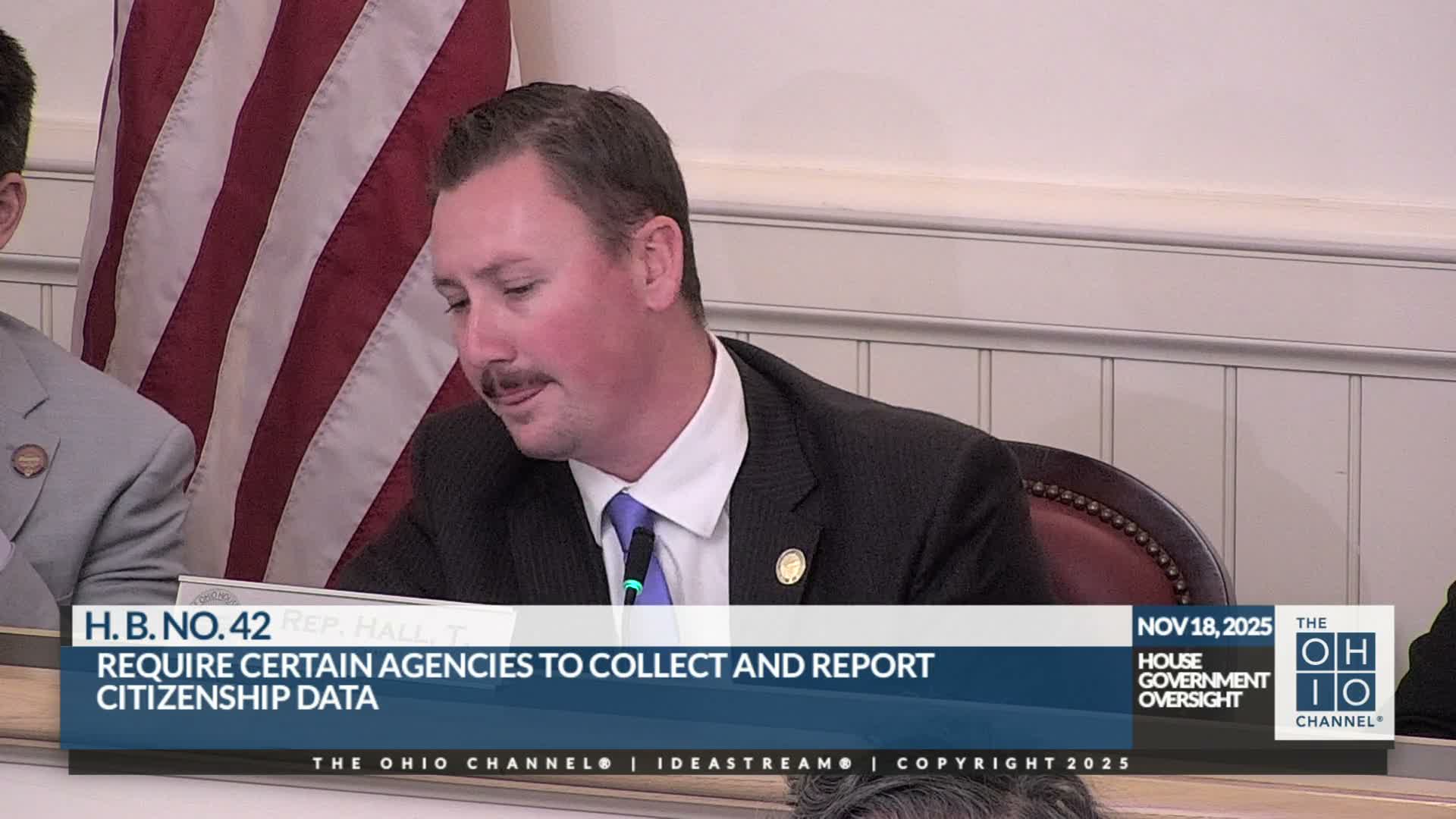
At a third hearing on House Bill 42, the committee heard a string of opposition from law-enforcement representatives, health providers and civil-rights groups who said the bill would impose heavy administrative costs and carry serious civil‑rights and public‑health risks. Heintz von Eckertsberg, legislative committee chair for the Ohio Association of Chiefs of Police, said his group "does not oppose the underlying goals" of the measure but warned that "local, county, and state law enforcement agencies in Ohio do not possess the ability to independently determine a person's immigration status" and that the bill's proposed follow-up queries could create substantial workload without delivering more accurate information. He suggested limiting the requirement to arrestees who are fingerprinted under existing state code.
Danielle Fierczyk, director of public policy for Planned Parenthood Advocates of Ohio and Planned Parenthood of Greater Ohio, testified in strong opposition and focused on the bill's application to Medicaid. She told the committee HB 42 duplicates federal verification processes and "largely functions to create a chilling effect in immigrant communities," risking reduced enrollment in life‑saving programs. Fierczyk cited federal rules on verification and said "less than 1% of total Medicaid spending goes to emergency care for non‑citizen immigrants," adding a testimony figure that fiscal‑year 2023 emergency Medicaid spending was cited at $3,800,000,000 (0.4% of total Medicaid spending) in her remarks. She warned that requirements to collect or report immigration data could be "weaponized" and referenced recent federal data‑sharing proposals that prompted litigation.
Ayesha Abdulahi of CARE Ohio (Council on American‑Islamic Relations, Ohio chapter) testified that HB 42 would require schools, law enforcement agencies, correctional institutions, county JFS offices and the Department of Medicaid to classify and report citizenship or immigration status and that doing so would duplicate federal processes, increase the risk of profiling and discourage eligible people from enrolling in services. She urged the committee to reject the bill.
A public commenter, Holly Braun, an educator and parent, said requiring schools to report immigration status would make parents fearful of sending children to school, and urged removal of schools from the bill or rejection in its entirety. Committee members asked witnesses whether they are hearing families forgoing care or pulling children from school because of fear; witnesses and commenters confirmed reports of fear and disengagement in affected communities.
Heintz von Eckertsberg and the other panels asked the committee to consider narrower language that aligns with existing fingerprinting practices and raised concerns about the burden on clerks, prosecutors, corrections and county agencies. Chair Hall closed the third hearing on HB 42 after testimony and questions; no committee vote occurred.