Lifetime Citizen Portal Access — AI Briefings, Alerts & Unlimited Follows
NCSL expert says states are racing to regulate AI as Alaska lawmakers weigh task force
Loading...
Summary
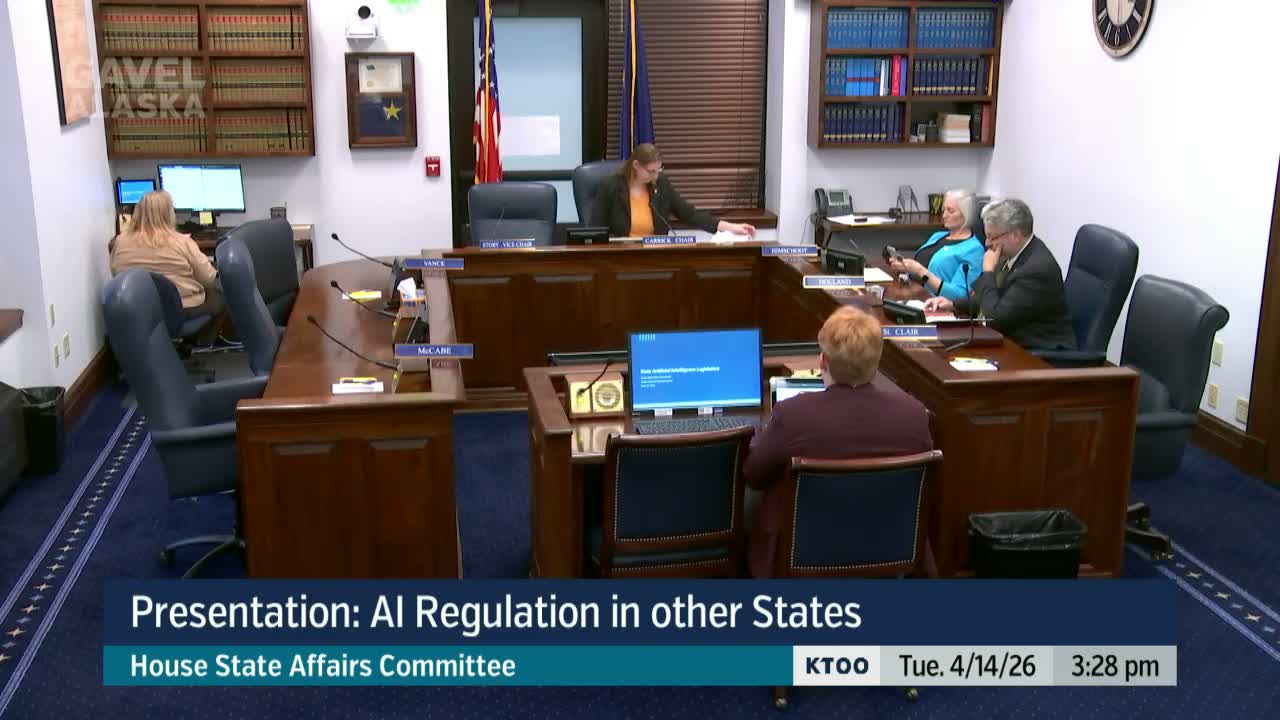
Darcy Cherry of the National Conference of State Legislatures told the Alaska House State Affairs Committee on April 14 that more than 1,100 AI-related bills have been introduced in 2026, and she outlined three state approaches—study/oversight, comprehensive laws, and targeted rules—as lawmakers asked how Alaska should proceed.
Darcy Cherry, director of the Center for Results Driven Governing at the National Conference of State Legislatures, told the Alaska House State Affairs Committee on April 14 that state legislatures are seeing a steep rise in activity on artificial intelligence, with “already, there have been 1,100 bills introduced” so far in 2026.
Cherry gave an overview of how legislatures are treating AI: many states are creating inventories, impact-assessment requirements and task forces to study government use; a handful have passed broad, comprehensive laws; and most states are focusing on targeted statutes that address specific harms such as deepfakes, health-sector uses, and algorithmic pricing.
The presentation, given to a committee that did not have a quorum for bill votes, framed policy choices for Alaska lawmakers. Cherry described three common approaches: (1) study and oversight through task forces or agency offices that inventory and review AI systems, (2) comprehensive statutes that regulate high‑risk systems and set disclosure and risk‑management standards, and (3) narrowly targeted laws aimed at specific problems such as election‑related synthetic content or commercial misuse.
Cherry cited examples across the country: Utah’s Artificial Intelligence Policy Act, which requires disclosures and created regulatory entities and civil penalties; Colorado’s Senate Bill 205, which targets high‑risk systems and mandates impact assessments (implementation delayed to June 2026); and 2025 laws in Texas and California that set disclosure and safety requirements for large models and certain deployments. She also described state pilots and executive actions — from Ohio Medicaid automation pilots to Hawaii’s wildfire‑forecasting work — as ways governments are experimenting with AI without full-scale adoption.
Committee members pressed for Alaska‑specific guidance. Representative Hemschute said Alaska had not yet passed AI legislation; Cherry replied that states occupy a continuum of responses and that many have enacted AI-related measures, but that targeted approaches are common because the technology’s scope can be overwhelming. Representative Holland asked whether task forces add value; Cherry said task forces can be useful when a state needs authority to collect information, synthesize use cases, and recommend policy.
On health care, Cherry said Arizona’s law prohibits use of AI to deny medical claims, and that Texas requires providers to review AI‑generated records or recommendations and retain decision authority. She added that several states require agency impact assessments to guard against bias when AI affects services such as education, employment, finance and health care.
Cherry also noted state approaches to encouraging innovation, including regulatory sandboxes and right‑to‑compute laws such as Montana’s, which aim to preserve space for AI development while placing limited guardrails. She told lawmakers NCSL is tracking both regulatory and pro‑innovation models and is assembling resources, including an AI policy toolkit and legislative tracking available through the NCSL website.
On federal interaction, Cherry said the administration had issued an executive order designed to limit some state regulation of AI and that portions of that approach were the subject of litigation, adding uncertainty about how federal action might affect state bills.
The committee did not take formal action. Chair Carrick said the bill noticed for the meeting would be rescheduled and that the House and Senate State Affairs committees would hold a joint hearing on April 16. The committee adjourned at 4:26 p.m.