Get Full Government Meeting Transcripts, Videos, & Alerts Forever!
Get email alerts on the Pediatric Extended Care topic
No spam. Unsubscribe anytime.
Families, providers urge Ohio to create prescribed pediatric extended care centers to keep parents working and reduce hospital days
Summary
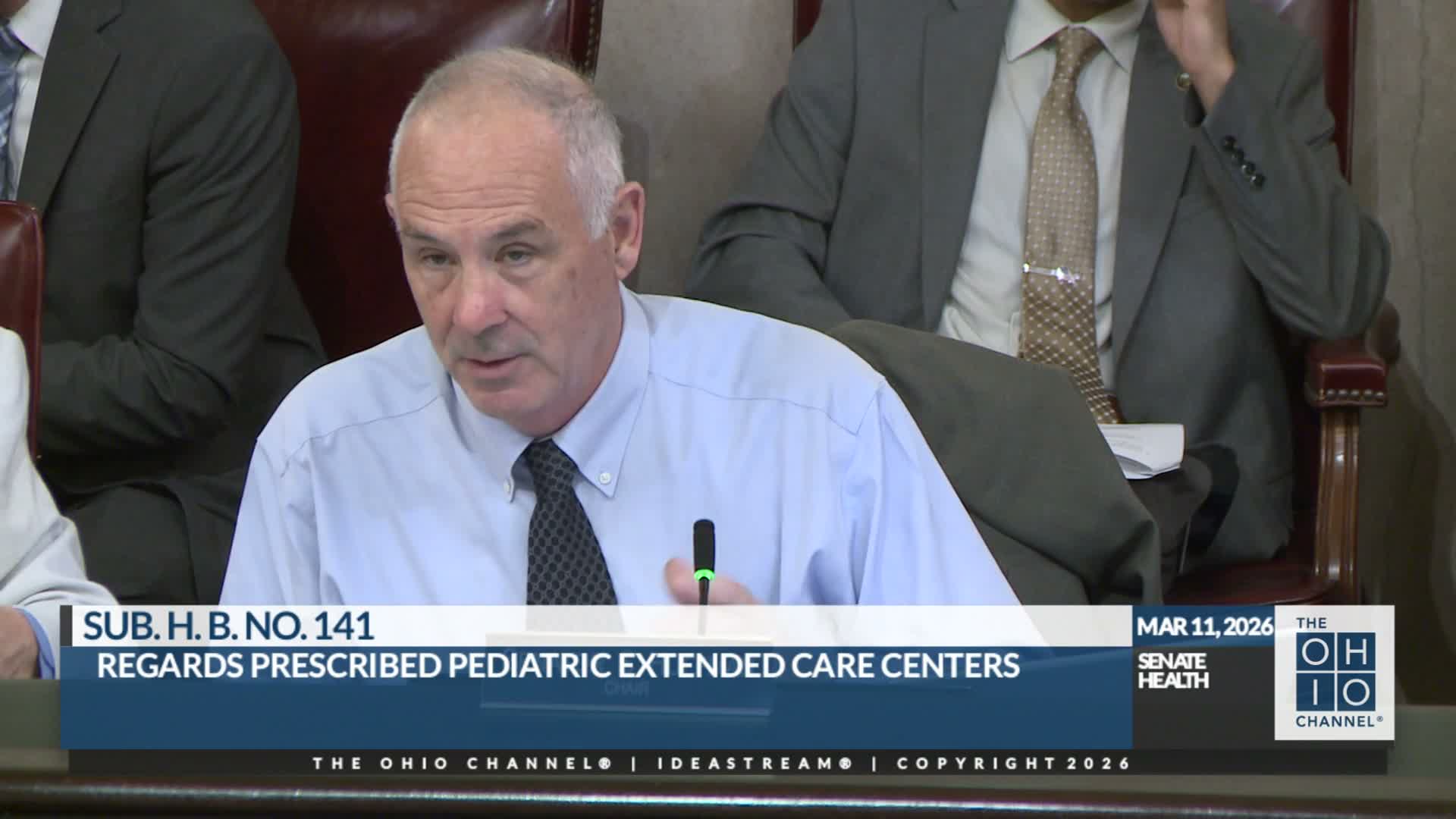
Providers, parents and pediatric specialists told the Senate Health Committee that House Bill 141 would create prescribed pediatric extended care centers (PPECs) to serve children with complex medical needs, reduce avoidable hospital days, and enable parents to remain employed; witnesses cited program examples, family stories, workforce concerns and potential Medicaid savings.
Multiple witnesses told the Senate Health Committee they support House Bill 141 to establish prescribed pediatric extended care centers (PPECs) in Ohio, a Medicaid-funded model that embeds nursing and therapeutic supports in licensed child-care settings so children with complex medical needs can attend safely and families can work.
Pam Green, president and CEO of Easterseals Redwood, described her organization’s PPEC model across the Ohio-Kentucky border and said the program prevented an estimated 50 emergency-room visits last year. “We estimate that our nurses prevented 50 ER visits last year,” Green said, and noted the cost of an ER visit to Cincinnati Children’s Hospital is $3,126 while an inpatient day in complex care can run about $15,232. Green said PPECs allow children to learn alongside typically developing peers while reducing hospitalizations and costs.
Parents and providers described real-world hardships that the bill would address. Amelia (Amelia) Auberger, a licensed social worker at Cincinnati Children’s and a parent of a child with complex needs, recounted years of high out-of-pocket private-duty nursing before waivers and said the absence of medical childcare forces families to consider leaving the workforce. Siobhan Magnuson described traveling to Kentucky’s Easterseals Redwood to access medically supported childcare for her son and said the program allowed her to return to work. Samantha Graves said a PPEC would provide early intervention, therapies and monitoring for her infant with a shunt and congenital aqueductal stenosis.
Clinical witnesses quantified demand and potential system impacts. Dr. Scott Callahan, medical director of the Complex Care Center at Cincinnati Children’s, said his clinic follows more than 750 medically complex children and that in 2022 his hospital’s patients experienced 3,952 avoidable inpatient days because of lack of community nursing; he estimated those inpatient days cost Medicaid and insurers about $22,500,000. Providers and operators said the state’s nursing shortage and detailed eligibility and rule-making questions (including how waivers such as Katie Beckett/Tefra are used) will be important to resolve in implementation.
United Rehabilitation Services and other providers said they already operate medical-childcare models but sustain losses because current reimbursement does not cover nursing and therapy costs: “We operate with a budget that loses about $300,000 to $350,000 a year,” a United Rehab representative said. Troy Hunter of Elevate DD cited survey data from more than 700 families showing Ohio’s childcare system is not meeting the needs of children with developmental disabilities and urged the committee to adopt another care option in the continuum.
Witnesses said House Bill 141 passed the Ohio House unanimously and that sponsors worked with the Department of Medicaid, the Department of Health and the Department of Children and Youth to address eligibility and implementation. Committee members asked about ways to staff and license centers, whether the bill would require the state to seek federal waivers and how eligibility and income considerations would affect access; witnesses said the details of eligibility, waiver requests and rule writing remain important next steps.
The committee completed the second hearing on House Bill 141 after extensive testimony; no final vote was taken at this session.