Get Full Government Meeting Transcripts, Videos, & Alerts Forever!
Get email alerts on the Education Funding topic
No spam. Unsubscribe anytime.
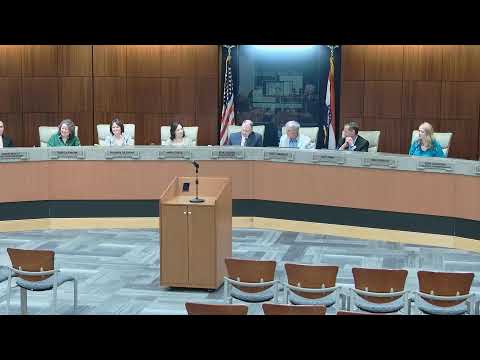
Blue Springs R-IV board raises alarms over state bills that could strip local school funding
Summary
At its March meeting the Blue Springs R‑IV board heard a detailed legislative update and urged parents to contact state lawmakers after staff warned several bills — including open enrollment and income-tax proposals — could reduce district revenue and require program cuts.
The Blue Springs R‑IV Board of Education spent a large portion of its March meeting on a legislative update that board members said could significantly cut local school revenue if several bills pass in their current forms. Jason Wolf summarized proposals on open enrollment, a statewide A–F grading plan, changes to property-tax structures and a constitutional amendment to phase out income tax.
"The tax dollars do not follow these students," Wolf said, raising a central concern about an open-enrollment measure he identified as bill 971. Under the bill as described to the board, districts could set limits on transfers (an initial 3% cap that could increase to 4% and then 5% after successive years) and would have to adopt policies defining "insufficient classroom space" for accepting transfers. Wolf said the provision in the proposal that tax revenue would not accompany an enrolled transfer student would leave districts with enrollment shifts but no corresponding funding.
Why it matters: board members said those shifts could force difficult decisions about programs that rely heavily on local property-tax revenue. President Swanson warned that local levies and services — including transportation, counseling and extracurricular offerings — depend on those taxes and could face cuts if the state reduces income- or property-tax revenue.
The update included other pending measures Wolf noted by bill number: a statewide A–F school grading plan (referred to as House Bill 2710), a suite of property-tax proposals (including references to House Bills 2780 and 2668) and HJR 173, a proposal Wolf said could gradually eliminate the state income tax (he stated the current income-tax rate as 4.7 percent). Wolf said the HJR language under some scenarios could remove income tax entirely within a multi-year window and that proponents expect offsetting sales-tax changes; he characterized the possible net fiscal impact to schools as substantial.
Board members pressed specifics and urged local response. "All taxes get paid — I don't care what form you put that in," President Swanson said, arguing the state-level changes would shift the tax burden and risk creating funding shortfalls for schools. Several board members described attending a recent legislative breakfast to advocate against the A–F grading proposal and other items; one board member said the district's legislators were among those who voted against aspects of the A–F bill.
What comes next: the board asked district staff to continue monitoring the bills and encouraged parents and residents to contact state lawmakers to express concerns. No formal district action or policy change tied to those bills was taken at the meeting; the session was a briefing and call to advocacy.
Sources and provenance: the discussion and direct quotes are drawn from the board's legislative update and subsequent member remarks heard in the meeting (topic introduced at SEG 1073; follow-up discussion through SEG 1560).