Get Full Government Meeting Transcripts, Videos, & Alerts Forever!
Get email alerts on the Council Operations topic
No spam. Unsubscribe anytime.
Pacific Fishery Management Council briefs new advisory members on procedures, travel and digital tools
Summary
The Pacific Fishery Management Council held an all‑advisory‑body briefing reviewing council operating procedures, conduct and harassment reporting, attendance and alternate rules (including a strict 30‑day alternate‑request deadline), stipend eligibility, travel and reimbursement via Concur, and the website and RingCentral platforms members should use.
Kelly Ames, deputy director of the Pacific Fishery Management Council, opened the council’s all‑advisory‑body briefing and reminded new appointees that the session was being recorded and will be posted on the Council’s website.
“Please take the time to familiarize yourself with our website,” Ames said, telling members the meeting recording and briefing materials will be available for future reference. She said the session would cover council operating procedures, advisory body ground rules and resources members will use while serving.
The briefing framed advisory members as a core part of the Council’s decision process. Executive Director Merrick Burden thanked attendees for their service and said advisory bodies make it possible for the Council to manage fisheries across a large geographic area. “What sets our council apart is the strong role of our advisory bodies,” Burden said, noting the Council’s work affects millions of people across Pacific coast fishing communities.
Council Chair Brad Pettinger urged appointees to act as ambassadors for their fisheries, stressing respectful dialogue and relationship building among panel members. Vice Chair Pete Hassimer said the Council’s work seeks both healthy ecosystems and sustainable fisheries and highlighted the March meeting’s California Current Integrated Ecosystem Assessment report as an example of upcoming material members should track.
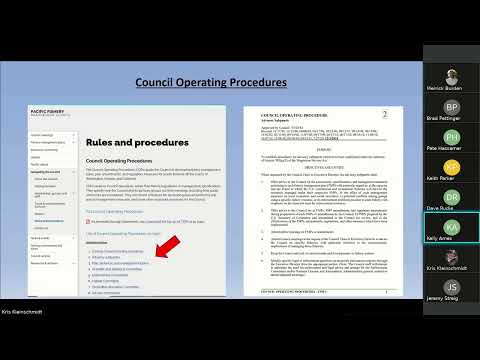
A key portion of the briefing summarized the Council operating procedures (CoPs) and membership expectations. Ames said CoP 1 governs council operations and that there are separate CoPs for advisory subpanels, technical teams and committees. She reviewed termination criteria for advisory subpanel members, including examples such as transferring employment or moving location, missing two meetings in a 12‑month period, inability to fulfill duties, or violations of conduct. Ames said the council chair, in consultation with the executive director, may remove a member for just cause.
Ames emphasized the Council’s conduct expectations and harassment reporting procedures, directing members to the rules and procedures page for the formal policy and investigation process. “Harassment will not be tolerated,” she said, and encouraged anyone who experiences or observes harassment to report it to the executive director or council chair so incidents can be investigated.
Attendance, alternates and stipends were laid out in practical terms. Ames said advisory members are expected to attend all meetings but that the CoPs allow for two absences per year; alternates may be approved but require deputy director review and executive director approval. She stressed a strict 30‑day deadline for alternate requests that was relaxed during the COVID era but will now be enforced. On stipends, Ames said payments are available to advisory members who are not federal employees or state marine fisheries agency staff, but that stipend payments are subject to availability of appropriations and require timely submission of required forms.
Ames also reviewed travel logistics: meeting invites constitute official travel orders and are sent from a noaa.gov account; invites will include hotel details, per diem rates and authorized travel dates; and members should use the JotForm provided to request hotel reservations by the stated deadline to avoid losing accommodations.
Chris Kleinschmidt, the Council’s IT manager, walked attendees through the Council website and the electronic briefing book system, describing dedicated meeting pages that host agendas, briefing book documents, e‑portal links for public comment and oral testimony, decision summaries and recordings. “The briefing book page is your one‑stop shop for all of the items related to the council meeting,” Kleinschmidt said.
Kleinschmidt explained the two RingCentral platforms the Council uses: RingCentral Video for day‑to‑day advisory meetings and RingCentral Webinar for formal council meetings. He described participant controls (mute, screen share, hand raise and chat), how to join from multiple device types or by phone, and the difference between attendee and participant roles in webinar settings.
On reimbursements and travel booking, Kleinschmidt introduced Concur as the Council’s expense and booking system. He said members must set up Concur profiles, attach bank accounts for reimbursements, and that Concur requires multifactor authentication; the Council maintains how‑to videos and will update them to match Concur’s interface changes.
The briefing closed with Ames asking members to return intent‑to‑serve forms if they have not done so, to monitor noaa.gov email notices from Council staff, and to contact assigned staff officers with questions. Staff remained available on the line for follow‑up after the recording ended.
The briefing primarily provided procedural guidance rather than policy decisions; no motions or votes were recorded during the session.