Get Full Government Meeting Transcripts, Videos, & Alerts Forever!
Get email alerts on the Energy Policy topic
No spam. Unsubscribe anytime.
House Environment and Transportation Committee advances Utility Relief Act to House floor
Summary
The committee voted 14–5 to advance a broad energy package (HB1532, the "Utility Relief Act") that makes temporary cuts to Empower Maryland surcharges, changes net energy metering rules and large‑load tariffs, creates a data‑center registry and redirects $100 million from the Strategic Energy Investment Fund to ratepayer relief for one year.
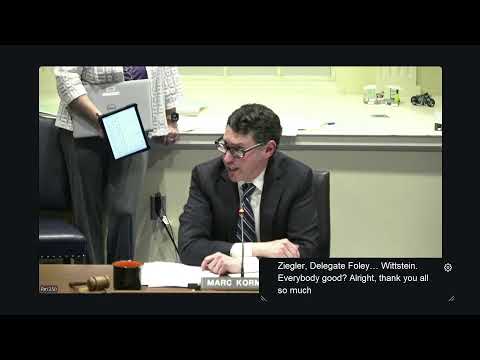
The House Environment and Transportation Committee on Thursday advanced HB1532 — titled in the amendment packet the Utility Reducing Energy Load Inflation for Everyday Families Act, or the Utility Relief Act — to the House floor after a 14–5 roll-call vote.
The chair, who presided over the committee, described the bill as “quite an undertaking,” telling members it consolidates many energy measures into a single package and carries two committee amendments: a technical title change and a substantive package of policy changes. “This bill is, quite an undertaking,” the chair said in opening remarks as the committee reviewed a reprint and a set of amendments that were distributed shortly before the meeting.
Why it matters: the bill mixes short-term rate relief and longer-term structural changes. Its most immediate effect would be to reduce near-term customer surcharges by (1) temporarily lowering Empower Maryland program goals and (2) using a one-year $100 million transfer from the Strategic Energy Investment Fund (CIF) to cover the first tranche of Empower spending, reducing the Empower surcharge for that year. The measure also rewrites compensation and caps for customer-sited solar (net energy metering), narrows certain Empower-funded measures (removing the gas-side surcharge), and adjusts the large-load tariff that applies to data centers and other very large customers.
Key provisions and committee discussion
- Empower Maryland and near-term relief: The amendment removes the gas-and-power surcharge for gas bills (with a transition period) and temporarily reduces the Empower goal from 2.5 percent to 1.75 percent for a three-year cycle, with incremental increases afterward. The chair said the change was intended to preserve program intent while easing immediate rate pressures for customers. Members pressed staff for details on how the percentages are calculated and how the CIF transfer affects the surcharge; the chair said the $100 million CIF transfer is a one-year subsidy that lowers bills during the period the money is applied.
- Net energy metering (NEM): The bill keeps a 3,000‑megawatt NEM cap but directs the Public Service Commission (PSC) to open a proceeding to set a new compensation model, bringing Maryland more in line with a growing number of states that no longer pay full retail compensation indefinitely. The committee added regional, service-territory caps to limit cross-subsidies for rural utilities and set a grandfathering approach (projects that have paid interconnection fees and are in service by a specified date may retain NEM 1 status for a transition period).
- Large-load tariff: The committee lowered the large-load customer threshold cited in the Next Generation Energy Act from 100 MW to 25 MW and adjusted the load-factor metric (from 80% to 75%) to capture more large customers — primarily citing concerns about data centers shifting costs onto other ratepayers.
- Data centers and transparency: The bill contains a nonbinding ‘statement of principles’ for data centers — encouraging local hiring, behind-the-meter storage, carbon-free assets and community engagement — and requires the PSC to create a data‑center registry to improve public transparency and help address so‑called “phantom” forecasting of capacity. Chair and members emphasized the registry is intended for public information and coordination with PJM, not immediate prescriptive limits on data-center development.
- Incentives for generation and ACP redeployment: The package includes a two‑year, $100 million-per-year reverse‑auction program funded by alternative compliance payments (ACPs) from the CIF to deploy renewables quickly; the chair said the goal is to redeploy ACP revenue into generation rather than see utilities pay ACPs.
- Other items: The committee adopted reforms to multiyear rate-plan reconciliation (allowing refunds to customers when reconciliation is favorable to ratepayers), required periodic ATT (advanced transmission technologies) studies for utilities, authorized portable/"balcony" solar, required meter-change requests be completed within five business days and added permit‑process improvements for rooftop solar including optional remote inspections where in‑person inspection delays exceed five business days.
Quotes from the hearing
- On the bill scale and process, the chair said: “This bill is, quite an undertaking.”
- On gas surcharges and Empower changes, the chair said plainly: “We are eliminating gas and power entirely” on the gas side, describing a transition mechanism to avoid a cliff for utilities managing legacy costs.
- On data centers and the large‑load tariff, counsel Steve (committee counsel) explained the change to the load factor “is basically just trying to catch a few more data centers by moving both of them in the same direction.”
- On the committee's work, Delegate Foley said: “This is a very massive project ... I think this is amazing work and really appreciate everything that you put in on behalf of Maryland ratepayers and the people of the state.”
Roll-call and procedural outcome
The chair moved the bill as amended; a recorded roll-call vote followed. The committee approved HB1532 with 14 members voting yes and 5 voting no. Members voting no raised concerns about the scale of generation changes and whether the package tackled certain large structural issues cited by some members; members voting yes cited short-term relief for ratepayers plus a broad set of longer-term tools.
Next steps
The committee chair said the bill will go to the House floor and is expected to be taken up Monday at 3 p.m. The chair and staff acknowledged there will be technical drafting corrections before the reprint and that the bill will receive a fiscal-note update before third reader.
Votes at a glance
- HB1532 (Utility Relief Act), motion to move the bill as amended — Committee result: Approved (14 yeas, 5 nays). The chair announced the bill will go to the House floor for further consideration.
Closing
Committee members thanked staff, counsel and agency partners. The committee adjourned after completing its roll-call and recording cosponsors as read into the record.
(Reporting based on the March 20 committee proceeding and the committee transcript.)