Lifetime Citizen Portal Access — AI Briefings, Alerts & Unlimited Follows
Hearing questions city’s environmental review of Lake Forest Park lakefront project, focuses on Wetland B access and SMP exceptions
Loading...
Summary
On March 10, 2026, cross‑examination of the city’s responsible official focused on the MDNS, the wetland delineation underpinning mitigation, anticipated public access through Wetland B, and which Shoreline Master Program provisions permit buffer exceptions; the examiner set written‑closing deadlines and a 6,000‑word limit.
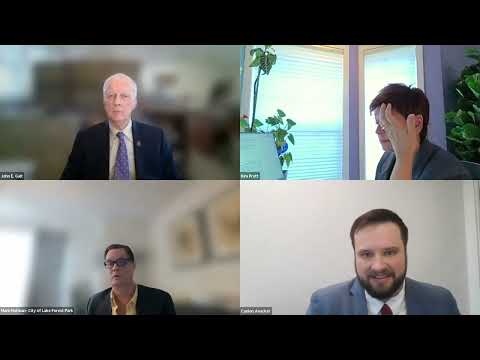
On March 10, 2026, during day nine of a contested hearing over the Lake Forest Park lakefront improvements and a SEPA appeal, the hearing turned to the adequacy of the city’s environmental review and the project’s treatment of wetlands and shoreline buffers. Appellant counsel, Mr. Anacker, pressed the city’s responsible official, Mr. Hoffman, about the documents and analyses that supported the city’s threshold determination of nonsignificance (MDNS).
Hoffman, who identified himself as the project’s responsible official and a community development director and shoreline administrator for the city, confirmed he signed the MDNS and that the threshold determination was made on 10/14/2025. He said his review relied on the SEPA checklist, the biological evaluation, the critical‑area report (including the wetland delineation dated 12/04/2023) and a traffic impact analysis (TIA) prepared by Transportation Systems. “The threshold determination was made on 10/14/2025,” Hoffman testified, and he said he included mitigation measures in the draft conditions of approval.
Counsel asked whether errors in the wetland delineation that increased minimum buffers would have altered the city’s permit recommendations. Hoffman answered that it would depend on the degree and nature of any error: a minor difference consistent with the analysis might not change the outcome, but a substantially different discovery (for example, an unexpected wetland in the middle of the site) could affect decisions. Counsel framed the question hypothetically: “If there were errors in the wetland delineation such that minimum buffers increased, would that change your determination on any of the permits?” Hoffman replied that the municipal code and SMP provide mechanisms to address erroneous information and that the answer would depend on whether new information altered the decision.
A central factual tension in the hearing concerned public access through the area labeled Wetland B. Counsel argued the project depends on users passing through Wetland B to reach the beach; Hoffman said the design funnels public access through a center corridor to provide access while avoiding altering Wetland B and that, under the SMP’s definition, some forms of passive recreation such as walking do not constitute a forbidden “alteration.” He also addressed a related property‑line issue: whether a navigational buoy line placed at the property boundary could create a trespass risk. Hoffman acknowledged the possibility of trespass from the east but said a buoy line at the property line is the appropriate tool to indicate adjacent private property and that the project’s approach is intended to limit conflicts.
Counsel examined whether the project met the SMP’s mitigation and enhancement standards (SMP section 3.40) and why the staff report cited SMP section 3.30(a), the exception provision allowing certain impacts to buffers when specified performance standards are met. Hoffman explained the SMP and appendices were considered in full and that 3.30(a) is the provision that contains exception language applicable to this highly disturbed site; he emphasized the site’s existing disturbed condition and the project’s design intent to avoid and preserve remnant wetlands where feasible.
On traffic and emissions, Hoffman confirmed the TIA was the primary traffic report relied on and that there would be some increase in vehicle trips when the park operates. He testified the scale of parking (about 10 onsite spaces and the designated off‑site parking arrangement) and peak‑hour trip generation did not rise to the level of a ‘‘significant probable adverse environmental impact’’ for SEPA purposes. Hoffman also stated no formal noise or solar/shadow studies were required for the threshold determination and that noise is mitigated through municipal code standards and park hours (dawn to dusk).
The parties also reviewed implementation details the record will require later if permits are approved: a monitoring and maintenance program prepared by a qualified professional (to be provided later in the permitting sequence), draft wetland monitoring performance standards (draft condition 19 in the staff report) and whether kayak racks or decks would be treated as equipment or structures under the SMP and building code. Hoffman testified kayak racks would be considered equipment, while decks more than 30 inches above grade can be treated as structures that trigger building/permitting considerations.
Procedurally, the hearing examiner entered four comment exhibits (Exhibits 67–70) into the record at the morning’s start and invited public testimony; no new public witnesses presented. The parties waived live rebuttal but reserved rights to file written closings. The examiner set a written‑brief schedule: the city’s closing brief is due March 17, 2026; the appellants’ closing brief is due March 24, 2026. Each closing is limited to 6,000 words for the body of the submission, and counsel agreed on the distribution procedure. The examiner closed the hearing at 11:55 a.m. and said no further evidence would be accepted after the record closes.
What remains in dispute for the examiner’s decision are factual and legal questions that counsel highlighted on the record: whether the wetland delineation and related mitigation quantitatively support the MDNS and permit recommendations; whether the SMP exception the city relies on is properly applied to reductions of stream or wetland buffers in this specific design; and whether proposed public access features and buoy placement adequately avoid impacts to adjacent private property and sensitive habitats. The examiner’s written decision will follow review of the closing briefs and the record.