Lifetime Citizen Portal Access — AI Briefings, Alerts & Unlimited Follows
Douglas County delays USGS groundwater report, votes to extend contract to June 2027
Loading...
Summary
After a USGS presentation on a Carson Valley groundwater model showing mostly small valley‑wide declines but localized drops near Gardnerville Ranchos, commissioners approved a no‑cost extension to June 30, 2027 to complete peer review and finish the report.
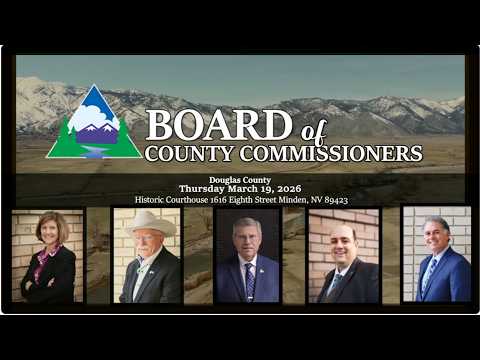
The Douglas County Board of County Commissioners on March 19 heard final results from a U.S. Geological Survey model of Carson Valley groundwater and approved a time extension through June 30, 2027 to allow the USGS to complete a peer review and publish the final report.
USGS hydrologist Chris Garner presented two model runs: a baseline holding 2020 pumping constant and a scenario that applies municipal pumping projections provided by the valley’s five purveyors. Garner said the scenario produces a slow decline in streamflow at the Carson City gauge and local declines in groundwater elevation. “If you take the last bar there, it’s approximately 75 acre‑feet for water year 2050,” Garner said, adding that converts to “0.1 CFS” compared with an average annual flow near 400 CFS at that gauge.
Garner and USGS staff framed the change in pumping as the single variable between the runs; other stresses — including domestic and irrigation pumping — were included in the model inputs but held constant so the analysis isolates municipal impacts. The model projects that most water‑table declines are less than about four feet by 2050, though a small, localized model cell near Gardnerville Ranchos shows declines up to roughly 18 feet.
Commissioners and staff repeatedly pressed USGS on domestic wells and local impacts in trouble spots such as Johnson Lane and Ruinstrauth. USGS and county staff said domestic wells are represented as stresses in the model data sets but that the presentation focused on municipal pumping; the agency said additional overlays — for example, historical drawdown at individual domestic wells — could be provided in the written report or as a follow‑on analysis.
Several residents told the board the presentation did not yet answer immediate local questions. “I’m not gonna be as gentle as you’ve been — considered a waste of time,” Johnson Lane resident Jim Jackson told the board, saying he saw little new information compared with earlier studies and was frustrated by the delay since the contract was authorized in 2021.
USGS apologized for the tardiness; the agency said staff turnover delayed completion and that the requested extension keeps the contract open so USGS can apply internal matching funds to finish the peer review at no additional county cost. Jenna Huntington of USGS said internal peer reviewers from Nevada and an external USGS reviewer will conduct the review and that the requested June 30, 2027 date “far exceeds the time I believe it will take.”
After discussion and public comment, Commissioner Hales moved and Commissioner Tolbert seconded a motion to grant the contract extension; the board approved it, with the record showing a 4‑0 vote and one absent. USGS and county staff said the extension is intended solely to permit peer review and finalization of the report, not to change the contracted scope without further board direction.
What’s next: USGS will complete the peer review and publish the final report; county staff and commissioners said they want additional local outputs (for example, overlays of domestic wells and historical drawdown) incorporated or provided as follow‑on material to inform a county water‑resource planning process.