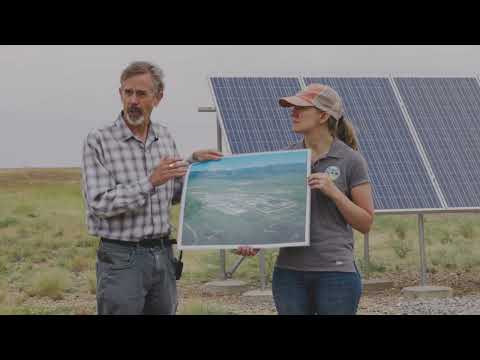
Presenter describes plutonium contamination, cleanup and ongoing monitoring at Rocky Flats' former 903 Pad
Loading...
Summary
A presenter on a Rocky Flats site tour described historical drum storage at the 903 Pad that released plutonium and solvents in the 1950s–60s, partial removal of contaminated soil (about 38 acres), and ongoing groundwater and surface-water monitoring, including erosion controls and a DOE-funded Stanley Lake protection bypass.
A presenter leading a site tour at Rocky Flats said thousands of drums were stored on the former 903 Pad in the 1950s and 1960s and “several hundred” leaked, contaminating near-surface soils with plutonium particles and groundwater with chlorinated solvents.
The presenter said the 903 Pad was excavated and backfilled in a partial cleanup; 38 acres of wind-blown surface soil were removed to meet an agreed soil action level of 50 picocuries per gram for surface soils. “The drums contained solvents with plutonium,” the presenter said, explaining plutonium tends to stick to silts, clays and fine grains and remains in near-surface soils under normal environmental conditions.
Why it matters: the site team monitors both groundwater and surface water because heavy rainstorms can mobilize residual surface plutonium and cause short-term surface-water exceedances. The presenter noted the contrast between the soil action level (50 pCi/gram) and the surface-water action level (0.15 pCi/liter), saying that even where soils are below the 50 pCi/gram standard, storm-driven transport can push surface-water results above 0.15 pCi/liter.
Supporting details: the presenter pointed out monitoring wells—white wellheads—used to track residual solvent plumes that generally migrate east and northeast and, under long wet periods, toward Woman Creek. The South Interceptor Ditch (SID), constructed in the 1970s to intercept surface runoff from the former plant, routes water to Pond C2; the SID can show elevated plutonium concentrations after heavy storms. The presenter said contaminated media from excavation were packaged and shipped off-site and that confirmatory samples were taken to ensure cleanup targets were met.
The Department of Energy funded the Stanley Lake Protection Project, the presenter said, describing a reservoir/bypass located between Pond C2 and Stanley Lake that captures Woman Creek flows and discharges them to Big Dry Creek so they bypass Stanley Lake, a downstream drinking-water source. The presenter emphasized that Woman Creek and on-site groundwater are not used as drinking water and that the nearest community intakes are miles downstream.
Site operations and controls: the presenter described erosion-control work and enhanced revegetation to stabilize soils, noting practical excavation depths of roughly half a foot to a foot to ensure contaminated surface material was removed. The presenter also pointed out on-site infrastructure: an East Shed used for equipment storage (built after the 2001 attacks), and solar and battery arrays that power groundwater treatment systems, monitoring stations and telemetry because the site is off-grid with no municipal power, gas, water or sewer.
What’s next: the presenter said monitoring of the 903 Pad plume and downstream areas continues, with wells positioned along the hillside and at the edge of Woman Creek to detect any plume discharge. No new votes or formal decisions were recorded during the tour segment.