Get Full Government Meeting Transcripts, Videos, & Alerts Forever!
Get email alerts on the Parks And Recreation topic
No spam. Unsubscribe anytime.
Grays Harbor College instructor lays out volunteer-backed plan to tame invasives and repair hazards at Mill Creek Park
Summary
Patrick Mahoney of Grays Harbor College presented an integrated pest-management and volunteer coordination plan for Mill Creek Park, urging a mix of manual removal, targeted herbicide use and native replanting; he and the mayor also identified a collapsed footbridge and hazard trees as grant priorities ahead of an Earth Day workday.
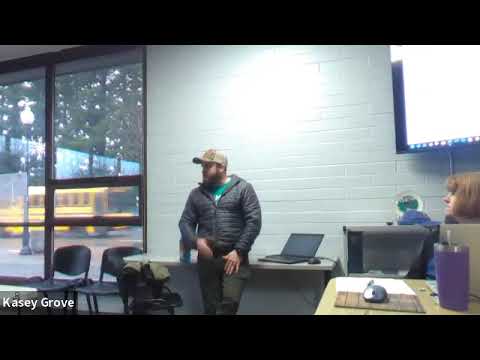
Patrick Mahoney, a forestry instructor at Grays Harbor College, told Cosmopolis city officials on March 18 that Mill Creek Park needs "serious vegetation management" to address widespread invasive plants, hazard trees near trails and a collapsed footbridge that prevents a full loop trail.
Mahoney said his students produced integrated pest-management plans that prioritize mechanical removal, targeted cut-stem herbicide treatments and replanting with native species. "If we just keep cutting it, it will keep growing back every year," he said of Himalayan blackberry. He described using cut-stem triclopyr and rotating herbicides to reduce resistance, and recommended pairing mechanical work with follow-up chemical treatments and native plantings to occupy cleared ground.
The plan identifies multiple invasive species—Himalayan blackberry, English ivy, knotweed and reed canary grass—that are crowding the pond and trails. Mahoney warned reed canary grass can form dense mats that "can build a foot or two of essentially organic soil" and choke waterways, and said the most effective long-term removal can require serious excavation.
Mahoney also raised public-safety concerns about aging red alder stands near trails. "Those alder trees that are there right now, they've got, I'm just estimating, 20 years," he said, adding that dying trees and ivy climbing trunks increase the risk of windthrow and falling limbs. He recommended a targeted hazard-tree assessment and said removing high-risk trees and replacing them with long-lived, shade-tolerant conifers (red cedar, Sitka spruce, western hemlock) would reduce future hazards.
The presentation outlined two priority zones within the park—near the dam/pond and on the west side—where student crews and volunteers could focus work and possibly add a simple loop trail. Mahoney said his program could commit two to three coordinated workdays a year and estimated that, with county technical support and additional volunteer groups, the city might secure eight to ten productive workdays annually.
Mahoney and Mayor Springer flagged the park footbridge as a concrete grant-ready project. "It would be wonderful to find some grant funding or find someone who would be willing to step in and help with that and get that rebuilt so that the trail system could go all the way around the pocket," Mahoney said; the mayor suggested including a bridge plan in grant applications.
On logistics, Mahoney described Earth Day activity planned for April 22 as a class day for his students and asked for community volunteers to help cut, bag and transport material to LeMay for disposal rather than chipping or mulching invasive species that risk spreading. He cautioned specifically against chipping knotweed. "There is no better way to spread knotweed than chop it up," he said.
Next steps recorded in the meeting: city staff and volunteers will coordinate Earth Day logistics; Mahoney recommended a formal hazard-tree assessment and continued coordination with the county Noxious Weed Control Board for licensed aquatic herbicide application where needed.
The presentation concluded with council and public questions about erosion, willow-stake bank stabilization, seedling sources and equipment needs for tree removal; Mahoney recommended low-cost willow wattles for bank stabilization as a first option and noted that arborist removal of large trees can cost several hundred to a thousand dollars per tree.
The college plans to provide maps and the student-created plans to assist the city in grant applications and volunteer scheduling. The city acknowledged the material and thanked Mahoney; the college-led Earth Day day of work remains scheduled for April 22.