Get Full Government Meeting Transcripts, Videos, & Alerts Forever!
Get email alerts on the Storm Response topic
No spam. Unsubscribe anytime.
Lexington leaders review ice-storm response after two severe winter events; city pledges deeper after-action review
Summary
Commissioner Nancy Albright told the council the city used over 19,000 gallons of beet heat, more than 4,600 tons of salt, about 70 vehicles and roughly 150 staff and contractors in the recent ice response. Council members pressed for clearer public tracking, neighborhood coverage and a detailed after-action plan.
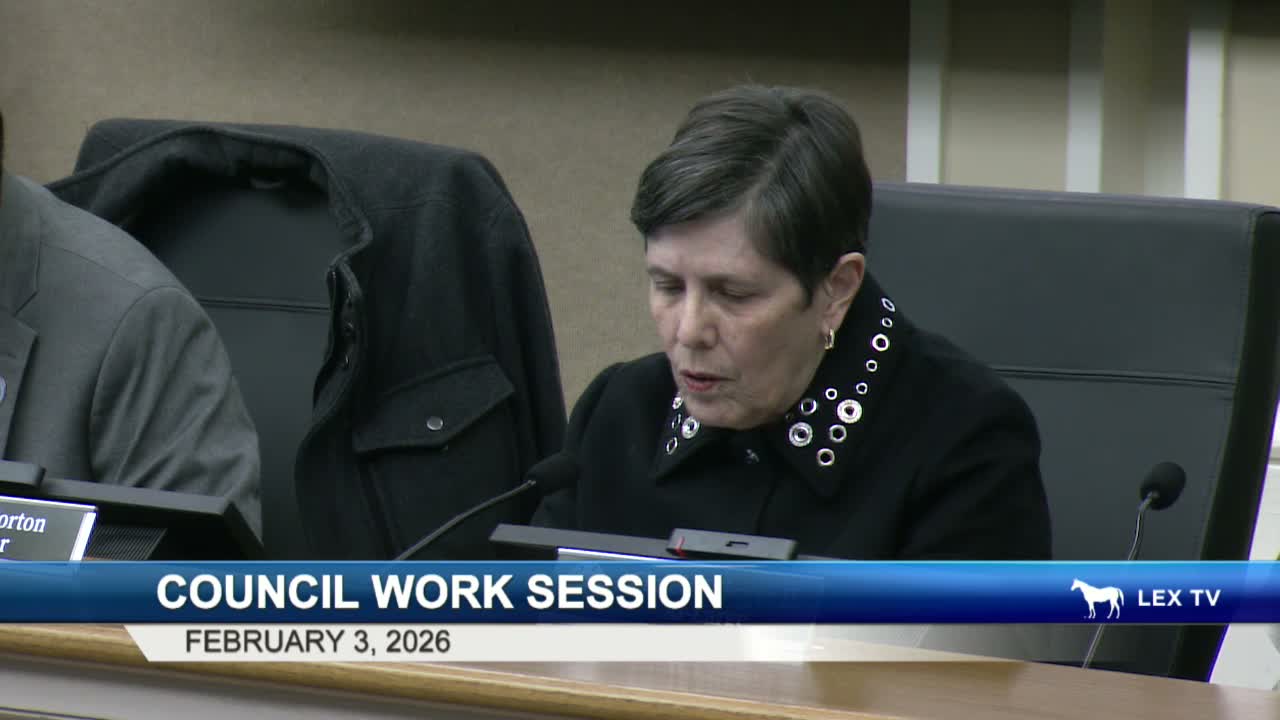
Commissioner Nancy Albright briefed the Lexington Fayette Irpin County Council on Feb. 3 on the city's response to a severe ice storm, saying crews have been operating since Jan. 24 and the response included contractors, heavy equipment and extensive overtime.
Albright said the city had used “over 19,000 gallons of beet heat,” more than 4,600 tons of salt, about 70 city vehicles and roughly 150 city and contract employees, totaling about 10,000 staff hours with approximately 2,000 in overtime. She told the council that, after the January 2025 event, the city added $2 million in one-time spending and has budgeted $3.5 million for snow and ice in FY2026.
The presentation emphasized priority sequencing for major corridors (including Man O' War, Broadway and Alumni), school bus routes and high-traffic event areas such as Rupp Arena. Albright said the city deployed two additional contractors and an "emergency response contractor" supplying loaders, skid steers and dump trucks to clear packed ice that standard plows cannot push effectively.
Council members pressed Albright on operational gaps exposed by the storm. Several members called for a public-facing tracker showing where crews are operating; Albright said the city previously offered a web-based tracker tied to GPS units but found the public-facing product unreliable because of connectivity and accuracy issues. She said an internal tracking system exists and the administration plans a deeper data review to verify where trucks were dispatched and whether routing or ranking logic needs revision.
Several council members raised particular concerns about neighborhood streets ranked 4 or 5 and some unranked roads that remained icy days after the storm. "We must do more, we must do better," said Councilmember Morton, urging immediate focus on neighborhood access, school routes and life-safety concerns. Albright responded that addressing every neighborhood at once would require a deliberate investment decision about equipment and staffing and that she will include those tradeoffs in a longer after-action review.
Vice Mayor Dan Wu and other members asked about the trade-offs of using construction equipment, which Albright said is more effective on packed ice but can damage pavement and equipment; the decision to deploy graders or similar machines often occurred "in the moment," she said, and staff try to use the least-damaging approach first.
Albright acknowledged mixed contractor performance in single-digit temperatures, noting older contractor trucks experienced mechanical failures. She also described 311 workflow limitations: the city's 311 system generates Salesforce tickets and routes them to supervisors, but tickets labeled "assigned" do not always indicate assignment to a specific driver in the field, which has created constituent frustration.
Public-safety leaders told the council they did not miss any fire responses and were able to transport patients using adapted vehicles. Fire Chief Jason Wells said crews made modifications, such as deploying smaller 4-wheel-drive vehicles and using EMS supervisors to access difficult locations.
Albright and the mayor said the city will conduct a deeper, multi-week after-action review rather than the quick review done after the prior storm, and they invited council input and specific 311 tickets to verify unaddressed roads. The mayor warned the council the changes recommended by that analysis could increase long-term costs and asked for patience while staff develop a careful, data-driven plan.
The council did not take formal policy action during the briefing but approved routine meeting minutes and asked Albright to return with the findings of the after-action review and any budget or policy proposals that emerge from it.