Lifetime Citizen Portal Access — AI Briefings, Alerts & Unlimited Follows
Wilsonville council directs staff to refine Town Center urban‑renewal feasibility under smaller redevelopment assumptions
Loading...
Summary
After reviewing revised scenarios that assume less redevelopment than the 2023 study, the council directed staff to continue refinements using the 10% reduction scenario (with an option to test a midpoint), emphasizing that feasibility figures are illustrative, not commitments to specific projects or properties.
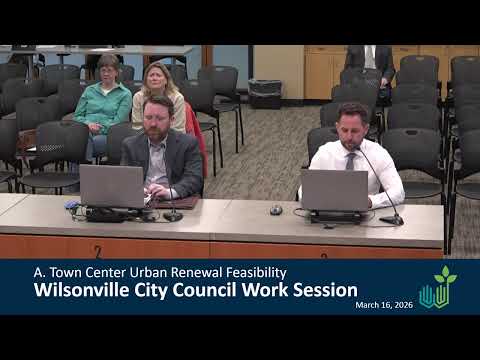
City staff and consultants presented revised feasibility scenarios for a possible Town Center urban renewal area and the Wilsonville City Council on March 16 directed staff to continue refining the analysis under a reduced‑redevelopment assumption.
Matt, a city planning staff member, told the council the 2023 study used “bullish” inputs and that two new scenarios test lower redevelopment acreage. He urged the council to treat the work as an analytical exercise, saying, “A feasibility study is not a statement of what will be built, and it is not a commitment about specific properties or a specific development outcome.” The updated scenarios reduce assumed redevelopment acreage by 10% and 25% and produce lower projected tax‑increment revenue and lower maximum indebtedness than the 2023 forecast.
Consultant Nick Popanak of Tiberias Solutions explained how the financial model translates staff inputs into a borrowing capacity forecast. Under the 10% reduction scenario staff cited a maximum indebtedness of roughly $89,800,000 (in 2026 dollars); the 25% reduction scenario yields about $78,500,000. Staff also stressed that debt proceeds become available over the life of a plan, not immediately: under the 10% scenario the agency could incur roughly $3 million in debt in the first five years.
Council members questioned assumptions that produced the 4,179‑unit figure from 2023, parking ratios, and the effect of the state’s vertical housing incentives on tax increment. Councilor Cunningham said the original town center plan promised 1,600 residential units and argued for the more conservative scenario; other councilors said the narrower reductions may be more politically viable and would preserve greater financing capacity for infrastructure. One council member suggested testing a midpoint (about 17.5%) in addition to the two presented.
The council did not vote on establishing an urban renewal area. Instead members provided direction: staff should continue refining the feasibility study with the 10% reduction scenario as the primary path while modeling an intermediate alternative for comparison, return in April with detail on how the 10% scenario changes the list of projects and indebtedness, and continue community outreach. Staff said that April 6 and April 20 work sessions could be used to finalize staff recommendations and potential ballot language.