Lifetime Citizen Portal Access — AI Briefings, Alerts & Unlimited Follows
Wilsonville planners present preferred West Railroad industrial concept, emphasize undercrossing, infrastructure and habitat protections
Loading...
Summary
City staff and consultants presented a preliminary preferred concept for the Basalt Creek master plan’s West Railroad area that aims to maximize industrial land while preserving wetlands and a regional trail. Commissioners pressed staff on the Grahams Ferry undercrossing, BPA‑easement constraints, wildlife impacts and funding options; staff will bring the concept to council April 20 and return with code details in June.
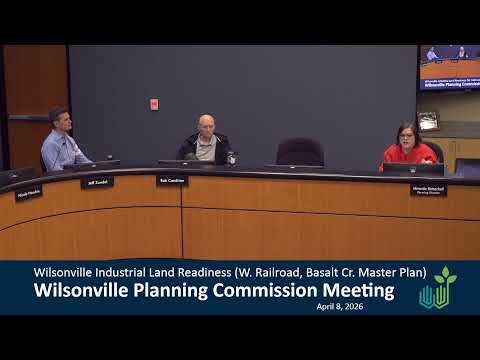
Wilsonville staff and consultants on April 8 presented a preliminary preferred concept for the Basalt Creek master plan’s West Railroad area that seeks to balance long-term industrial job growth with habitat protection and regional trail connections.
“For the record, my name is Chris Myers. I’m a senior planner here at the city of Wilsonville and the project manager for the Basalt Creek master plan project,” said Chris Myers as he introduced the consultant team and the evening’s purpose. Lauren Scott of the consultant team summarized site constraints — limited sewer, water and stormwater; constrained road access; remaining habitat along Coffee Lake/Coffee Creek; and a railroad and BPA easement that bisect the site.
The preferred concept presented by staff blends two earlier approaches: one that emphasizes natural features and trail connections and another that prioritizes regional manufacturing and freight access. The proposed graphic concentrates developable industrial land in a central “purple” area while preserving wetlands along the western edge and integrating an alignment for the Ice Age Tonkin Trail.
The city shared results of a DKS transportation analysis using a 20-year planning horizon and the preferred land-use scenario. Staff said the analysis assumed planned network improvements identified in the city’s transportation system plan and did not factor a public crossing at Cahalan as a baseline assumption. Lauren Scott said the analysis found the internal circulation layout performs adequately at the assumed development intensity and that “no major off‑site road upgrades are needed beyond what the city is already planning for and what’s adopted in the transportation system plan.”
Commissioners pressed staff about a low railroad undercrossing on Grahams Ferry Road that today limits truck access. One commissioner asked whether the project depends on fixing that undercrossing; staff replied that the undercrossing is likely to be needed for the area’s long-term development, would be expensive and would require coordination with the railroad operator. In describing coordination, a staff member said conversations with the railroad are ongoing and that a public crossing at Cahalan is “not off the table” but was not included in the baseline transportation assumptions.
The Coffee Creek Urban Renewal Area also surfaced in discussion as a potential funding source for large regional projects such as the Grahams Ferry undercrossing; staff said some projects are identified under that plan but funding and prioritization would require additional CIP and policy decisions.
Commissioners raised environmental and public‑realm concerns: impacts to wildlife crossing Grahams Ferry, the nature of the Coffee Creek wetland, mosquito concerns for waterside retail, and the possibility of locating trail connections or limited parking within the BPA easement. Staff said the city has not yet completed a targeted wildlife‑impact analysis for the crossing and would consult the natural resources program; they also said BPA typically restricts structures in easements but can allow paths or parking subject to negotiation and caveats.
Several commissioners urged caution about preserving enough developable acreage to meet the region’s industrial readiness goals while maintaining natural areas. Others asked whether the city has expressions of developer or employer interest; staff said prospecting specific employers is generally not part of the planning scope, though market input has informed feasibility work.
Next steps: staff will incorporate commission feedback into the April 20 council briefing of the same concept, return to the commission in June for land‑use/code discussions and tentatively pursue adoption hearings in the fall. The commission took no formal action or vote at the work session.
The project’s key open issues are funding and scheduling for the Grahams Ferry undercrossing, whether and how a public or pedestrian rail crossing at Cahalan could be pursued, the outcome of further wildlife and wetland analyses, and precisely which infrastructure projects would be carried in the city CIP versus developer-funded improvements.