Get Full Government Meeting Transcripts, Videos, & Alerts Forever!
Get email alerts on the Wvma Cup topic
No spam. Unsubscribe anytime.
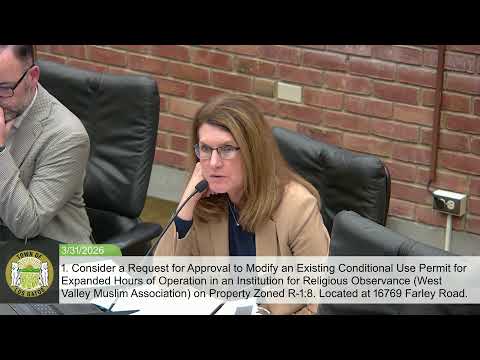
Los Gatos planning commission continues decision on mosque hours, orders mediation
Summary
After hours of public testimony over traffic, noise and CEQA, the Town of Los Gatos Planning Commission unanimously continued a request by the West Valley Muslim Association to expand operating hours at its Farley Road facility and directed voluntary mediation; the item was set to return April 22, 2006.
The Town of Los Gatos Planning Commission on March 31 continued a decision on a conditional use permit modification sought by the West Valley Muslim Association (WVMA) for expanded hours at its Farley Road facility, directing the parties to attempt voluntary mediation and setting a return date of April 22, 2006.
Opponents who live near 16769 Farley Road told the commission the requested change would substantially alter neighborhood livability and safety. "This is not about religion," one neighbor said. "It's about fairness, livability and neighborhood balance," citing late-night noise, headlights, blocked driveways and a lack of sidewalks. Several residents asked the commission to require a new, independently conducted noise study, a fire marshal audit and an audit of the existing CUP's compliance before considering expanded hours.
Supporters and faith-community witnesses urged the commission to accommodate religious practice and noted that congregational prayer times are tied to sunrise and sunset. Leaders from nearby mosques described strategies they use to manage overflow parking and pedestrian movement during Ramadan and other high-attendance periods.
The applicant's representative told commissioners WVMA has sought to work with neighbors and offered operational mitigations including traffic guards, planted screening, shielded lighting and a willingness to explore parking-lot expansion. "We have always extended our hand on a continuous basis to our neighbors," the applicant representative said. Asked how many vehicles to expect during non‑Ramadan sunrise prayers, the representative estimated roughly 30–50 cars on weekdays and up to 70–100 on weekends; during peak Ramadan evenings the applicant said it had recorded as many as about 850 attendees on some nights.
A central legal point in the hearing was whether the change required environmental review under the California Environmental Quality Act. The applicant's attorney argued the application does not expand the nature or number of prayers or people using the facility and therefore meets the CEQA exemption for existing facilities. Neighbor counsel countered that an increase in intensity and hours can trigger review and cited case law cautioning against relying on mitigations to characterize a project as exempt.
Town staff told the commission they relied on CEQA Guidelines '153.01 (exemption for existing facilities) and outside counsel in concluding the requested changes represented a negligible expansion of use; staff also described the limited scope for the CEQA exceptions (unusual circumstances or cumulative impacts) absent substantial evidence to the contrary.
Public works staff and the fire marshal's office briefed commissioners on street geometry, fire-department circulation criteria and the town's capital improvement project process for potential street or sidewalk work. Public works said measured widths along Farley Road meet a 36-foot threshold that generally allows parking on both sides while maintaining emergency access, but said larger infrastructure changes would require council-directed capital funding.
After discussion and competing proposed motions, the commission voted unanimously to continue the item and directed the parties to try voluntary mediation with a mediator experienced in religious-land-use law; the motion included a return date of April 22, 2006 and stated the applicant would pay the mediation costs (a point the applicant said it preferred not to fund entirely). The continuance was framed by commissioners as an attempt to reach a negotiated set of operational conditions rather than decide a contested permit change that many said would leave residents unhappy.
The commission closed the public hearing and adjourned the meeting. The continued hearing on the WVMA CUP modification is scheduled to return to the Planning Commission on April 22, 2006.