Get Full Government Meeting Transcripts, Videos, & Alerts Forever!
Get email alerts on the Fafsa Fraud topic
No spam. Unsubscribe anytime.
Committee advances trio of FAFSA and student-aid fraud bills amid privacy concerns
Summary
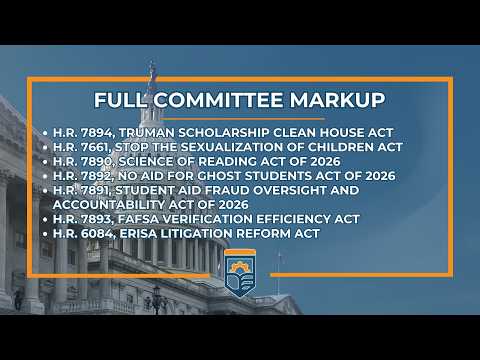
The committee advanced several bills (HR 7891, HR 7892, HR 7893) to strengthen identity verification in FAFSA and to prioritize program reviews of institutions that disperse aid linked to suspected identity fraud. Members praised fraud prevention but raised alarms about delaying aid and expanded collection of citizenship data.
The Education and Labor Committee moved forward three related measures addressing fraudulent FAFSA applications and verification processes.
Representative Thompson described the Student Aid Fraud Oversight and Accountability Act (HR 7891) as a response to so‑called ghost‑student schemes that diverted nearly $90 million in 2025, proposing a priority-review mechanism for institutions that disperse federal aid connected to suspected identity fraud. Representative Owens and others explained HR 7892 (No Aid for Ghost Students Act), which would require the Department of Education to implement identity‑fraud detection across FAFSA and require institutions to verify flagged applicants in person or via live video before disbursing aid. Chairman Wahlberg introduced HR 7893, the FAFSA Verification Efficiency Act, to authorize Social Security Administration verification for all FAFSA contributors and to allow citizenship indicators to be used in identity matching.
Supporters said the measures are necessary to protect taxpayer dollars and ensure aid reaches legitimate students. Opponents, led by Ranking Member Scott and others, urged narrowing of program‑review triggers to avoid penalizing institutions for single errors and warned that expanding citizenship verification could chill applications and risk misuse of data for immigration enforcement. Several amendments to limit citizenship collection and to require Department of Education guidance were proposed; the ANSs were agreed to and recorded votes on key amendments were ordered and recorded in the committee transcript.