Lifetime Citizen Portal Access — AI Briefings, Alerts & Unlimited Follows
Dr. Matt Skresky urges parents to 'name it to tame it' at Essex County gifted‑children night
Loading...
Summary
At an Essex County Gifted and Talented Committee parent night in Cedar Grove, clinical psychologist Dr. Matt Skresky advised parents and teachers to reduce outbursts by focusing on frequency, intensity and duration, using coregulation, concrete language and simple routines; he stayed for a lengthy Q&A and shared slides via QR code.
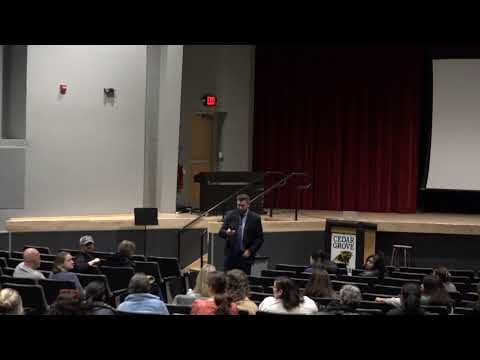
Dr. Matt Skresky, a clinical psychologist and professional speaker, told parents at an Essex County Gifted and Talented Committee Parent Night in Cedar Grove that naming children’s emotions and focusing on the "big 3" — frequency, intensity and duration — can make severe emotional outbursts shorter, less intense and less frequent.
Skresky, who delivered a roughly 90‑minute presentation to parents and county committee members, said the goal of therapy "is not to make your feelings go away. It is to make them smaller, last shorter, and happen less often." He framed his talk around practical techniques for teachers, school counselors and families of gifted and neurodivergent children and illustrated them with classroom and counseling anecdotes.
Why it mattered
Parents and educators in the room told Skresky they often face meltdowns that disrupt classrooms and family life. He argued that understanding the brain’s stress responses and using simple behavioral strategies can prevent escalation and preserve safety while supporting children’s emotional development.
What he recommended
- Name emotions to calm physiology: Skresky said that putting feelings into words — a technique he summarized as "name it to tame it" — helps activate the parasympathetic nervous system and speeds physiological calming. "When you name how you're feeling, it activates the parasympathetic nervous system to calm you down faster," he told the audience.
- Coregulate, then problem‑solve: During high‑intensity episodes his advice was to hold space and ensure safety rather than demand immediate explanations. He demonstrated how repeating a calm assurance — "I love you. You're safe with me. I'm not gonna let anything happen to you" — can deescalate an acutely distressed child.
- Separate content from process: Rather than arguing about facts (the content), Skresky urged caregivers to ask what process or unmet need is driving the behavior (the "why now"), which can unlock more effective responses.
- Practical tools: He recommended low‑cost, routine practices such as carrying a car "go bag" (snacks, quiet toys, noise‑canceling headphones), using code words, putting phones in airplane mode during meltdowns, changing the environment (a walk), and praising small, prosocial behaviors to build momentum.
- "Special time": For building ongoing resilience, Skresky cited psychologist Russell Barkley's "special time" strategy — 20 minutes of child‑directed attention twice a week — as an inexpensive, widely applicable intervention.
Examples and context
Skresky used several anonymized stories from his work with school‑age children to show varying levels of need, from a six‑year‑old who used violent replacement language to an older child whose shame over a thrifted coat explained repeated acting‑out. He said these cases illustrated how behavior often masks unmet needs such as hunger, tiredness or social embarrassment.
Audience questions and follow‑up
During a generous Q&A, parents asked about starting points for implementation, how to help teens label emotions, whether therapy helps reluctant adolescents, approaches to oppositional behavior (including strategies for children on the autism spectrum), and sleep routines for middle‑schoolers. Skresky offered concrete scripts, behavioral cues and referrals; he also provided a QR code linking to his slides and contact information and remained after the session for individual follow‑ups.
Attribution and caveats
Skresky made a number of specific neuroscience and developmental claims to explain why gifted or twice‑exceptional children can struggle with regulation (for example, statements about differences in neural connectivity and later maturation of the prefrontal cortex). Those scientific and numeric assertions were presented as the speaker’s professional observations and were not verified during the event. The article attributes those claims to Skresky rather than presenting them as independently confirmed facts.
Organizers and next steps
The event was hosted by the Essex County Gifted and Talented Committee; Melissa Hill, an officer on the committee, opened the evening and introduced cohosts Chelsea Clark and Dave Ackerman. Skresky encouraged attendees to scan the QR code to access slides and to contact him for further resources.