Get Full Government Meeting Transcripts, Videos, & Alerts Forever!
Get email alerts on the Low Income Energy Assistance topic
No spam. Unsubscribe anytime.
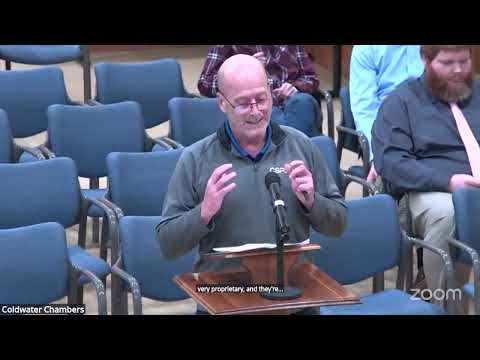
Coldwater BPU votes to opt out of Michigan Public Act 95 for FY 2026–27
Summary
The Coldwater Board of Public Utilities voted to opt out of Public Act 95, keeping low‑income electric assistance local and relying on a third‑party administrator rather than a statewide $1.50 per‑meter surcharge the MPSC set for this year.
The Coldwater Board of Public Utilities voted to opt out of Michigan’s Public Act 95 for fiscal year 2026–27, choosing to keep assistance funds local and continue using a third‑party administrator to direct payments to qualifying customers.
Director Nikki told the board that Public Act 95, enacted in 2013, establishes a mechanism for low‑income electric assistance and that the legislature revised the law in 2024 to encourage broader participation. "This year, the PSC or the MPSC has set the amount at a dollar 50," Nikki said, noting that the $1.50 per meter rate would require the utility to show roughly $135,000 would be available for assistance rather than the roughly $112,000 shown under last year’s rate.
Why it matters: opting out keeps the assistance and administration local and avoids the per‑meter surcharge being remitted to the state. Nikki described the board’s winter disconnection policy — "we will not disconnect if the temperature's gonna be below 34 degrees over a 48 hour period" — and said Coldwater has preferred to handle qualifying and distribution locally through a third party, Jacobs Well Ministries, while DHHS performs income eligibility screening.
Board members asked procedural and legal questions. One member asked whether the board must act each year; Nikki replied that under the amended statute the governing board must consider the decision annually and either opt in or opt out.
Nikki recommended the board opt out for FY 2026–27. The motion to opt out was made and the board voted to approve the recommendation.
What’s next: The board’s decision preserves the utility’s current practice of using a third‑party administrator and keeping assistance dollars available locally rather than paying the state surcharge.