Lifetime Citizen Portal Access — AI Briefings, Alerts & Unlimited Follows
Larimer County officials warn record-low snowpack and surge in red-flag days heighten 2026 fire risk
Loading...
Summary
County officials and the sheriff's Office of Emergency Management told the Board of County Commissioners that a record-low statewide snowpack (about 24% of median), an unusually high number of red-flag warnings and strained air and personnel resources have raised the county's wildfire risk; officials described early staffing, technology partnerships and a proposed faster fire-restriction authority.
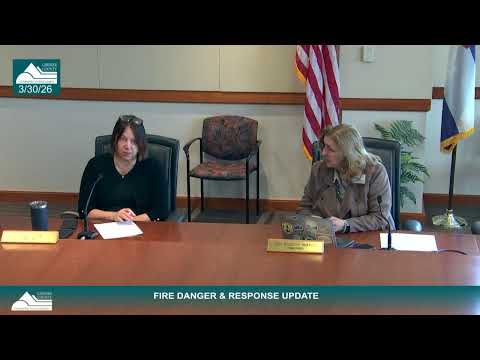
Larimer County officials told the Board of County Commissioners on March 30 that 2026 is shaping up to be an unusually dangerous wildfire year, citing record-low snowpack, pervasive drought and an early surge in red-flag warnings.
"It is as grim as we think it is," Justin Weitzel, chief of emergency services for the Larimer County Sheriff's Office, told commissioners during a work session. He said statewide snowpack was "about 24% of the median average" as of the briefing and that the South Platte Basin — which encompasses Larimer County — was near 38% of median. Those figures, he said, combine with unusual winter warmth and low soil moisture to increase fire spread and extend post-containment mop-up times.
Weitzel said the county has already recorded 18 red-flag warnings this year in Zone 238 (the plains below 6,000 feet), a pace that exceeds totals from recent severe years. "We've already had 18 from January to today in Zone 238," he said, and he warned that a single day could shift small, containable fires into large, fast-moving incidents.
Commissioners and public-safety leaders raised multiple operational concerns. Weitzel and Sheriff John Fan cited limits on rapid aviation response after noting single-engine air tankers normally based at Fort Collins–Loveland will be displaced for about 160 days while the runway is resurfaced; that change will require aircraft to come from greater distances and could slow initial suppression efforts.
To increase readiness, county emergency managers are moving seasonal resources earlier than usual. Weitzel said the Phantom Canyon wildland crew (8 full-time positions historically supplemented by part-time staff) will be brought on earlier than the typical April 30 start date, and the sheriff's office has expanded an on-call firefighter program (over 100 participants this year, up from about 85 last year).
Technology partnerships are also part of the county's strategy. Weitzel described access to about 10 cameras provided by Xcel Energy and integration of Pano AI and low-Earth-orbit satellite detections to give earlier automated notifications. County leaders said those systems are free to the county (paid for by the private partner) but noted gaps remain — especially coverage into the Estes Valley, where no Xcel camera currently looks into the park or town.
Weitzel emphasized a life-safety posture for evacuations: "I'd rather move people out of the way ... than wait and be like, well, we should have evacuated them an hour ago." He pointed to the 2020 Cameron Peak response, when more than 30,000 evacuations occurred with no reported fatalities, as evidence the county favors early large-scale action.
Officials also described funding and authority issues. Weitzel and Sheriff Fan said grants covered roughly 87% of Phantom Canyon's costs last year, with the county covering about 13%. Fan said county staff are planning to propose a future board item that would let the sheriff enact fire restrictions unilaterally in urgent situations, with the board to ratify that action later — a change intended to avoid multi-day delays during rapidly evolving incidents such as Alexander Mountain.
Commissioners repeatedly stressed public education and interagency coordination. Weitzel announced a regional coordination summit scheduled for April 24 that will include more than 30 partner agencies from adjacent Colorado counties and federal partners to align incident command and resource sharing.
The meeting closed with a reminder from Chair Commissioner Jody Shabick Nally about local responsibility and readiness: "We are the Calvary, and we have to kind of understand that," she said, urging continued work on funding and staffing options as the county prepares for a long, active season. The session was adjourned at 12:01 p.m.