Lifetime Citizen Portal Access — AI Briefings, Alerts & Unlimited Follows
Rep. Gabe Evans and Energy Secretary Chris Wright call for more U.S. power generation and criticize some Colorado policies
Loading...
Summary
At an Xcel Energy event, Rep. Gabe Evans and Energy Secretary Chris Wright urged building more affordable, reliable electricity generation, criticized Colorado energy mandates as costly, and framed grid reliability as essential to jobs and economic growth. Claims cited were presented by the speakers and not independently verified.
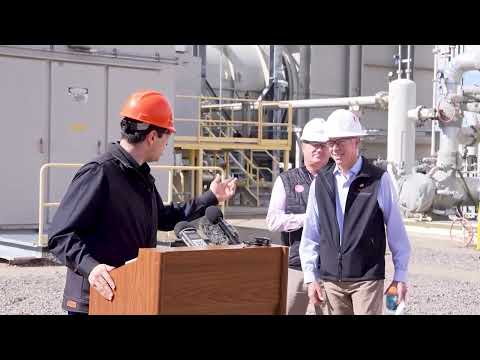
Congressman Gabe Evans, who represents Colorados 8th Congressional District, and U.S. Energy Secretary Chris Wright urged expanding domestic electricity generation and criticized some state energy policies during remarks at an Xcel Energy facility near the Fort Saint Vrain site.
Evans said the Colorado Energy Offices own study "shows that the energy policies that they're pushing in the state of Colorado cost $61,000,000,000 above ... the current baseline," and argued that spending on those policies leaves less money for grid investments needed to prevent outages. "When we gotta spend $61,000,000,000 just here in the state of Colorado for ideological policies instead of science driven policies around energy, all of that stuff impacts the folks that are working to keep the lights on," Evans said.
Evans also told attendees that his district contains major energy assets, including the Fort Saint Vrain facility, and said municipalities in his district have told him that "power is the biggest limiting factor" to local economic growth. He cited a projection that the nation needs about 165 gigawatts more generation in the next four years, which he said would serve "enough for 50,000,000 homes," and added that a local electric provider projects needing three times as much power in the next decade.
Evans highlighted two pieces of federal legislation he supports: the SPEED Act, which he described as permitting reform intended to speed large projects, and the FIRE Act, which he said would reform air-quality permitting so wildfire smoke from outside a state does not "punish American and Colorado jobs." Both were presented as priorities for reducing barriers to new generation.
"So I'm proud to be a cosponsor of the SPEED Act," Evans said, and described the FIRE Act as designed to "fix our air quality permitting and not punish American and Colorado jobs."
Secretary Chris Wright, whom Evans introduced, framed the national agenda similarly. "If we lower the cost of energy, we lower cost across the whole economy," Wright said, adding that lowering energy costs would make states more attractive to business and support wage growth.
Wright criticized how he said renewable portfolio standards are implemented in some states, asserting that "the 28 states with renewable portfolio standards today have 50% higher electricity prices on average than the 22 states that didn't do that." He argued that mandates can leave a grid with insufficient dispatchable capacity at peak demand and that affordable, reliable generation is needed to keep prices down and enable industry growth.
To illustrate reliability concerns, Wright pointed to past extreme-weather events in other regions and said that actions taken during the prior administration included keeping backup generators running to avoid prolonged outages. He said those steps, along with delaying the closure of certain coal-fired capacity, reduced deaths and large-scale outages in some cases.
Both speakers framed their remarks as policy prescriptions aimed at increasing domestic generation capacity to support manufacturing, data centers and other energy-intensive industries. No formal votes or policy actions were taken during the event; the session consisted of prepared remarks and commentary.
All numeric claims and citations of studies or past administrative actions in this report are attributed to the speakers and were not independently verified by this reporter. The article notes where a speaker said a study or number supports a claim and treats such items as assertions rather than established fact.