Lifetime Citizen Portal Access — AI Briefings, Alerts & Unlimited Follows
Oregon City commissioners press ODOT for business compensation, timeline before approving five-year park access extension
Loading...
Summary
Commissioners and public commenters pushed back on Oregon Department of Transportation’s request to extend temporary work-area use of John Storm Park and Sportcraft Landing up to five more years for the Abernathy Bridge project, demanding clearer timelines, compensation for affected businesses and a plan before any action.
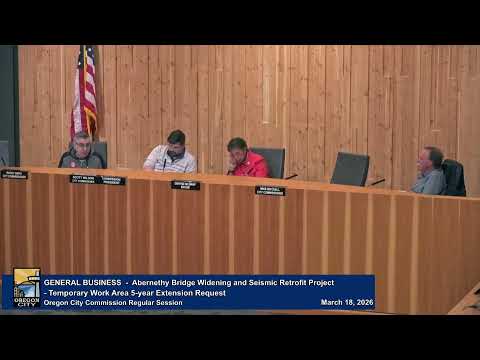
The Oregon City Commission heard a detailed update and robust public comment Wednesday on a request from the Oregon Department of Transportation (ODOT) for a five-year extension of temporary work areas in John Storm Park and Sportcraft Landing tied to the Abernathy Bridge seismic retrofit and widening project.
ODOT Region 1 project delivery manager Matt Fritag and area manager Fidel Francis told the commission the project completed the in-water work in the Willamette River and has installed structural steel and other retrofits; the agency said the contract completion date is currently October 2026 but the contractor’s latest schedule shows a likely finish in May 2027. ODOT outlined follow-on subsurface soil-mixing work the agency expects to take about two years (2028–29) and landscaping in 2030. The extension request is for time only, the presenters said, with no change to work-area footprints or mitigation commitments.
Commissioners repeatedly pressed ODOT and city staff for specifics. One asked when construction actually started — distinguishing notice-to-proceed from physical mobilization — and ODOT said it would confirm the exact first-on-site date but had recorded a 2022 notice associated with the project. Commissioners also questioned whether the explanatory statement sent to voters, which said “up to 4 years,” is a binding limit or merely an estimate; city staff said the charter language does not explicitly make that timeline a binding constraint and asked the commission for direction.
Public commenters representing nearby businesses and neighborhood interests urged the commission to decline an open-ended extension without stronger mitigation. Raymond, a Transportation Advisory Committee member speaking for himself, said the ballot explanatory statement explicitly limited work to “up to 4 years” and warned that approving five more years without voter approval would set a bad precedent for using charter parks for extended projects. Sam Drivo, a small-business owner located under the bridge, said his business has seen steep declines in revenue since staging began (he cited a 61% decline in visitation and roughly $1 million cumulative losses across seasons) and asked for renegotiation of lease terms and compensation.
Several commissioners said ODOT’s schedule changes and the contractor’s recovery plan raised real concerns for nearby businesses. One commissioner noted three businesses are directly affected, reporting as much as a 50% drop in income, and said the commission should not act until ODOT negotiates a compensation agreement. ODOT representatives acknowledged business impacts, said the agency is working with right-of-way staff on compensation proposals, and described short-term measures such as signage to help customers find open businesses.
Commissioners asked whether the subsurface ISM work could be done without the parks access ODOT currently uses. ODOT said the soil-mixing work must happen at the current access location and that alternatives have not yet been fully evaluated. Commissioners stressed they need a dollar figure for compensation, clearer confirmation of timelines (including actual mobilization dates), and proposals for mitigating business and park access impacts before deciding whether to approve an extension or put the question to voters.
The commission directed city staff and ODOT to return with the requested information as soon as possible; staff said they would move quickly and bring the item back to the commission (a two-week return timeline was discussed). No formal extension was approved at the meeting.
The commission will revisit the item after ODOT and staff provide a clearer schedule, a compensation proposal for affected businesses, and documentation about what the ballot explanatory statement promised voters.