Lifetime Citizen Portal Access — AI Briefings, Alerts & Unlimited Follows
Energy Secretary Christopher Wright says U.S. production, trades and diplomacy will blunt oil shocks
Loading...
Summary
U.S. Secretary of Energy Christopher Wright told studio interviewers that military operations, diplomatic talks and U.S. production and storage policies should reduce the risk of prolonged extreme oil-price spikes, while short-term disruptions could still raise gasoline and diesel prices.
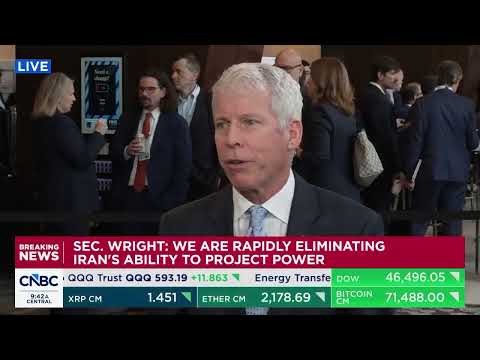
U.S. Secretary of Energy Christopher Wright said in a studio interview that U.S. energy policy and expanding domestic production should limit long-term price shocks even as the ongoing conflict with Iran creates short-term disruption.
"We are rapidly eliminating Iran's ability to project power to its neighbors," Wright said, attributing recent military operations and the administration's posture to reduced regional threats and opening space for negotiations. He added that the government will need to establish which Iranian actors have authority in any talks.
Wright told host Brian that while business leaders should plan for a range of scenarios, an extreme outcome — invoking oil at $175 per barrel — is "highly unlikely." He credited high U.S. output and diplomatic engagement with oil producers, saying some exporters prepositioned stocks overseas as tensions rose.
Addressing U.S. strategic stocks, Wright said the Strategic Petroleum Reserve (SPR) was "damaged" by drawdowns in 2022 and that his office is pursuing trades that swap near-term deliveries for larger volumes returned next year. "We're trading a barrel for delivery in the near term for over 1.2 barrels of oil for delivery back to us later next year," he said, and predicted the SPR would hold more oil at the end of next year than it does today.
On consumer impact, Wright acknowledged the public feels gasoline and heating costs more directly than crude prices and said officials are examining refinery efficiencies and other levers to bring pump prices down quickly.
When reporter Sarah Eisen asked about a suggestion the U.S. and Iran could jointly control the Strait of Hormuz, Wright said allowing Iran to control the strait would be "unacceptable" and that the goal is to remove or dramatically reduce Iran's ability to threaten the waterway while ensuring free flow of shipping for all nations.
Wright also addressed production and refining. He said U.S. oil and gas operators are "patriotic" and are keeping refineries running at higher capacity, and pointed to a reported increase in Venezuelan output — from under 1,000,000 barrels per day to roughly 1,200,000 barrels per day in recent months — as a source of heavy crude that can help produce diesel.
Asked whether the U.S. should block diesel exports to lower domestic prices, Wright warned that blocking exports would force refineries to reduce throughput and thus would be counterproductive. He said the administration has ideas to bring additional diesel to market "before tomorrow" and that U.S. LNG production will help fill gaps created by outages elsewhere.
Wright said large LNG projects such as Golden Pass (a joint venture between ExxonMobil and Qatar Energy) are coming online in the near term and that American LNG growth will continue to expand to meet global needs.
The interview closed after roughly 30 minutes with Wright reiterating that U.S. energy production and policy choices aim to mitigate the current disruption while delivering long-term benefits.