Get Full Government Meeting Transcripts, Videos, & Alerts Forever!
Get email alerts on the Data Center Ordinance topic
No spam. Unsubscribe anytime.
Grant County planning subcommittee begins drafting data‑center ordinance amid debate over noise, water and decommissioning
Summary
The Area Planning Commission Data Center Subcommittee met March 11 to begin drafting a county data‑center ordinance; staff outlined draft language on definitions, noise limits, setbacks, water reporting and decommissioning while members asked for stricter protections and clearer enforcement.
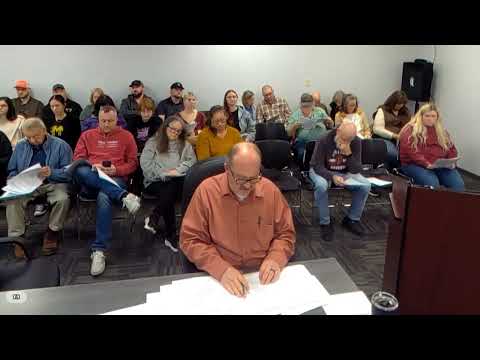
Randy Atkins, president of the Area Planning Commission, convened the Area Planning Commission Data Center Subcommittee on March 11 to begin drafting a county ordinance that would govern the siting and operation of data centers in Grant County.
Todd Glancy, executive director for the Area Planning Commission, presented three reference documents: a survey of other Indiana counties’ ordinances, a December 8 outline of ordinance goals, and a March 2 draft scaffolding with sample language. Glancy said the scaffolding covers core items the subcommittee must decide, including precise definitions (data centers versus cryptocurrency mining), permitted zoning districts, minimum site standards, setbacks and buffers, noise and vibration limits, lighting, water and cooling requirements, electrical coordination, traffic and construction standards, screening and fencing, annual transparency reporting, decommissioning requirements and enforcement provisions.
On noise, Glancy proposed measuring limits at property lines (offering 55 dB as an example) rather than at individual residences; several members urged lower property‑line limits and larger minimum setbacks because data centers operate 24/7 and can generate continual droning. Committee discussion referenced existing solar setbacks in the county (examples in the draft: 500 feet on one side, 750 feet on a second side) and suggested those would be insufficient for data centers, with one member proposing setbacks measured in miles for adjacent residences.
The subcommittee discussed backup power and battery storage. Members agreed battery storage needs explicit treatment—Glancy noted the county excluded battery storage in its solar ordinance and recommended the group study a separate battery standard or explicit battery rules in the data‑center ordinance. A participant also raised whether the ordinance should allow new technologies (including small modular nuclear reactors) as optional backup power sources, and members agreed that would require further research and explicit ordinance language.
Water and cooling systems drew sustained attention. Glancy said the draft scaffold prefers air‑cooled or closed‑loop systems, requires disclosure of cooling technologies in applications, and would ask operators for an annual water usage report (total annual gallons, peak daily usage and peak flow rates). The draft would allow baseline well sampling and periodic monitoring where warranted and would trigger notice to the APC when annual water use increased more than a set percentage year‑over‑year (the draft suggests 15% but the subcommittee can set a different threshold).
Members repeatedly raised concerns about local aquifer impacts and discharge temperatures. Speakers cited past local industrial projects and cases in Indiana where cooling discharge lowered water tables or harmed nearby wells. Glancy said some operations require IDEM permits and that the BZA (Board of Zoning Appeals) could attach conditions as part of a special‑exception review.
The committee also examined enforcement and decommissioning language. Glancy pointed to an enforcement section in the March 2 draft and said it needs further detail; members recommended financial assurances or bonds to guarantee funds for decommissioning and environmental remediation if a company fails or abandons a site. They discussed whether buildings could be repurposed and noted state procedures for change of use and commercial design release would apply.
Atkins asked staff to gather additional studies and model ordinance language from other counties, to refine noise and water standards, and to draft enforcement and decommissioning provisions for the subcommittee to consider in follow‑up meetings. The subcommittee did not take formal votes at the meeting.
The APC scheduled to accept public input and said it will notify the public when the next subcommittee meeting is set.