Get AI Briefings, Transcripts & Alerts on Local & National Government Meetings — Forever.
House Ways and Means hears how $11.1 billion House Bill 2 grew and where dormant capital funds might be freed
Summary
House Ways and Means members pressed facility planners on March 23 about $1.4 billion in reauthorized priority-one funds and how to reclaim dormant appropriations from HB 2 to free cash for shovel-ready projects. Agency officials outlined steps taken to identify inactive projects and explained P5 as a future-year placeholder.
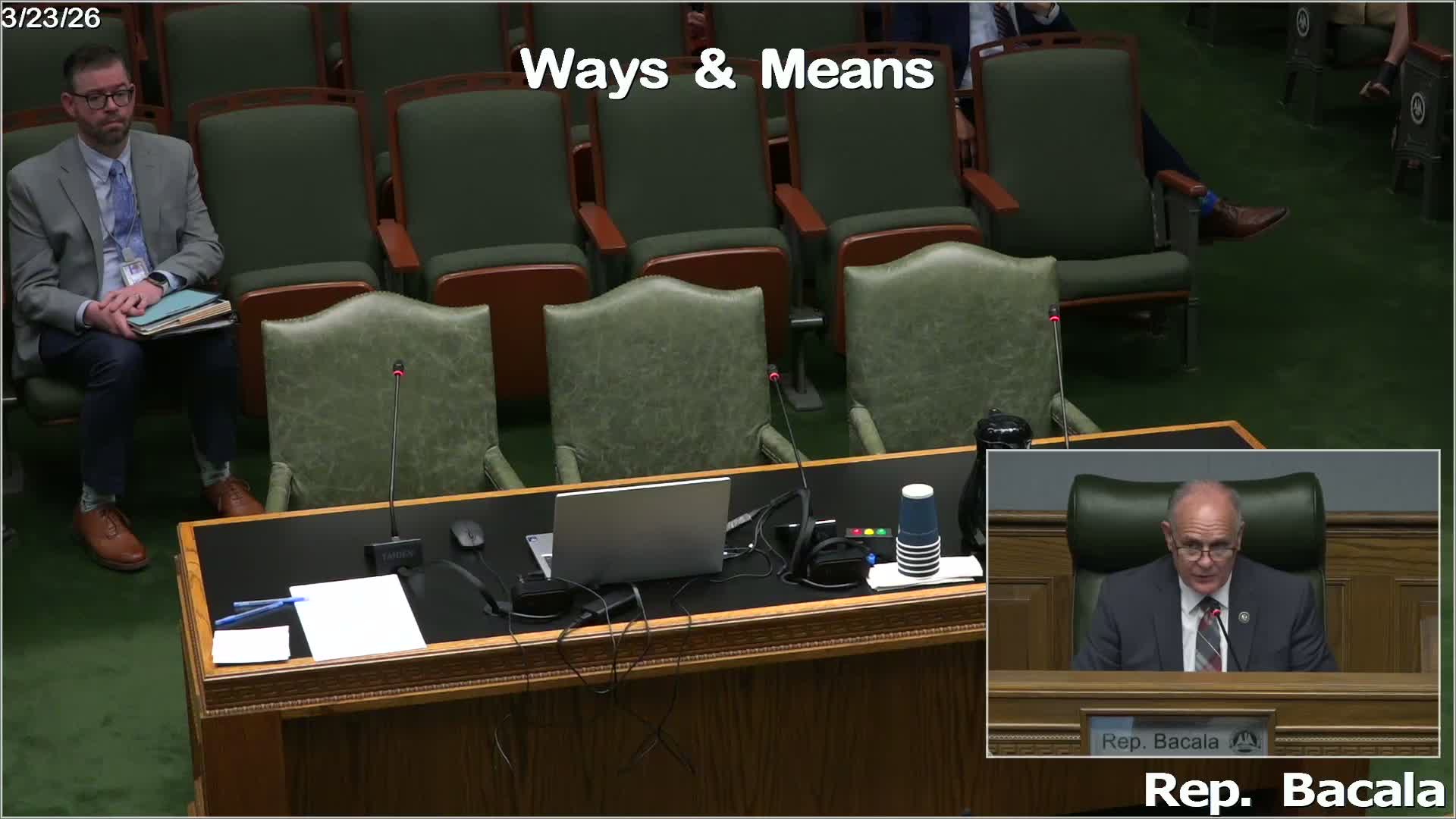
The House Ways and Means Committee on March 23 heard an informational briefing on House Bill 2, the state's capital outlay bill, as lawmakers pressed agency officials for ways to free up dormant funds and reduce what several members called "false expectations" from Priority 5 listings.
Roger Husser, assistant commissioner in the division administration for Facility Planning and Control (FP&C), and Matt Baker, director of FP&C, told the committee the original HB 2 draft stands at about $11.1 billion and that the division is working to narrow projects that are unlikely to spend in the coming year. "There are roughly 90 members have requested roughly $250,000,000 in additional money," Chairman Bakker said when opening the meeting, and Husser and Baker answered detailed process questions from legislators.
Why it matters: Lawmakers said P5 entries in the bill create misleading public expectations because P5 is a noncash placeholder. Baker explained the mechanics: "On November 1, that's when all capital outlay requests are due to be submitted in eCourts," and FP&C runs December-January cash-flow analyses to determine what can reasonably be moved up to Priority 1 (P1). Baker told members the new P1 capacity this year is about $574,000,000 in line-of-credit capacity while roughly $1.4 billion of P1 in the bill is reauthorized carryover from prior years.
Lawmakers' concerns and agency responses: Representative Jackson called the unspent allocations "monopoly money," arguing it inflates what local officials think is immediately available. FP&C said it has run a dormancy exercise: projects that had no expenditures for about 18 months (operationally reviewed as two years) were flagged and some were removed from reauthorization. Margaret Hill, assistant director over capital outlay and the nonstate program, told the committee that in the list reviewed last week there remained $45,000,000 in cash that had not been spent and which "we can do that within HB 2" to reallocate, and that the nonstate dormant list included projects representing roughly $80 million in P1 lines at the earlier check.
Nonstate projects and oversight: The panel pressed FP&C on how much of HB 2 funds nonstate entities (municipalities, parishes, ports, special districts and some nonprofits). Baker said nonstate projects make up about 29% of the current original bill and that nonstate P1 is subject to a statutory 25% limit of available P1 capacity; nonstate recipients generally must provide a 25% match (in-kind counted in many cases), though some exemptions exist.
Process fixes proposed: FP&C said its recent steps include identifying dormant projects and working with administering agencies (DOTD, CPRA, LED and others) to better cash-flow projects and reduce reauthorizations. Baker said he would judge success if reauthorizations fell to a 20%–30% rate rather than the current higher figure, and Husser said the division has brought on third-party project managers and other staff to improve completion rates.
What's next: Committee members urged more precise reporting so they can notify local officials and help determine which projects truly need funds this fiscal year. FP&C committed to follow up with detailed reporting on the dormant list and the split between political subdivisions and nongovernmental organizations. The informational hearing concluded with higher-education representatives preparing to present their campus-specific project questions to the committee.