Lifetime Citizen Portal Access — AI Briefings, Alerts & Unlimited Follows
Committee backs bills to let state seize, destroy adulterated imported seafood and track invoices
Loading...
Summary
The House Committee on Agriculture moved two seafood bills forward March 26: HB121 would allow the Department of Agriculture and Forestry to seize and destroy imported seafood found to contain antibiotics, dyes or other adulterants; HB725 (amended) requires retailers to retain invoices for six months for traceability. Lawmakers said the measures support coastal harvesters and public safety.
A House Committee on Agriculture advanced two bills March 26 aimed at protecting consumers and supporting Louisiana’s seafood industry.
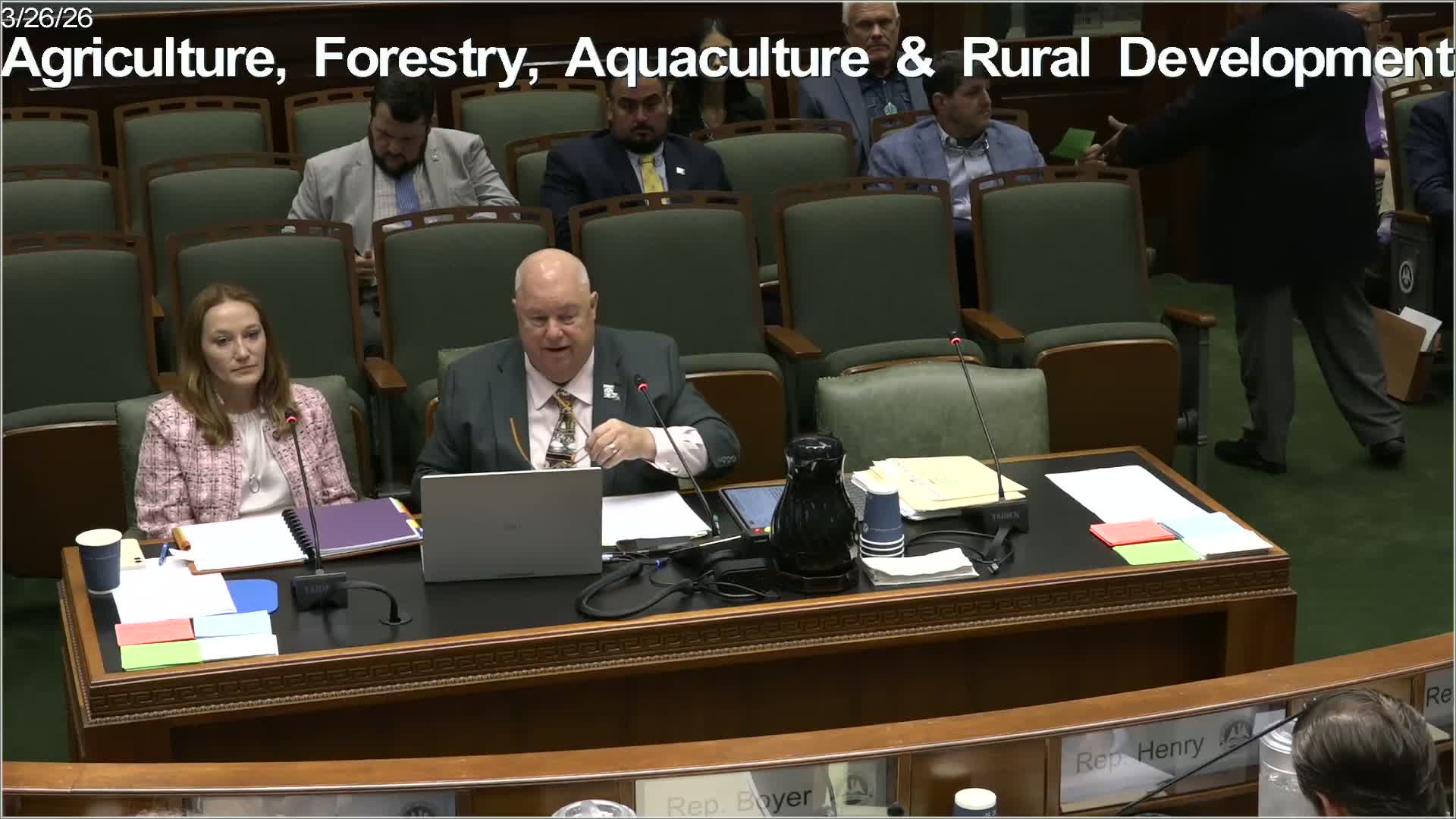
Representative Domingue introduced House Bill 121, which would give the Department of Agriculture and Forestry authority to seize and destroy imported seafood that tests positive for prohibited antibiotics, dyes and other adulterants. The current law authorizes the department to test and issue stop orders, Representative Domingue said, but leaves the physical seizure and destruction to the Department of Health and Hospitals. Commissioner Strain told the committee that HB121 closes that enforcement gap by allowing weights-and-measures personnel to remove contaminated product from commerce.
Commissioner Strain said the department conducts preliminary and confirmatory testing (three tests per sample at an accredited state lab) and currently takes about 10 samples per week. “So in addition to us ordering it not to be moved, not to be sold, we can go ahead and pick it up and get it out of commerce,” he said.
Members asked whether the bill would raise consumer costs. Representative Bagley said restaurateurs and retailers already report tight margins; Commissioner Strain replied that HB121 targets contaminated product and would not materially affect the price of imported shrimp, which is driven by currency exchange and tariffs. He said the additional enforcement would be performed by existing weights-and-measures staff and would not require state general funds.
The committee also moved House Bill 725 with a technical amendment changing the one-line description from “restaurants” to “retailers.” HB725 requires retailers to retain invoices from imported-seafood vendors for six months so auditors can trace country-of-origin and supply chains. Commissioner Strain said records often suffice to determine origin and scope of a shipment and are far less expensive than lab tests in many cases.
Vice Chairman Travis Johnson moved HB121 and other committee actions; the chair recorded no objections and reported the bills favorably.
Next steps: both bills were reported favorably by the committee; they proceed to the next legislative stage for further consideration.