Lifetime Citizen Portal Access — AI Briefings, Alerts & Unlimited Follows
Town consultants propose pipe‑lining to limit wetland disturbance during Lynnbrook Road water‑main replacement
Loading...
Summary
PAR presented a plan to rehabilitate a ~50‑year‑old water main under Lynnbrook Road using a cured‑in‑place structural liner, limiting excavation in wetland buffers to about 280 square feet; the Conservation Commission asked for final design and dewatering details and continued the hearing to April 30, 2026.
PAR wetland scientist Siever Anderson and consultant Jason Anderson told the Southborough Conservation Commission that a proposed Lynnbrook Road water‑main replacement would use a cured‑in‑place structural liner to avoid open‑cut excavation through a wetland easement.
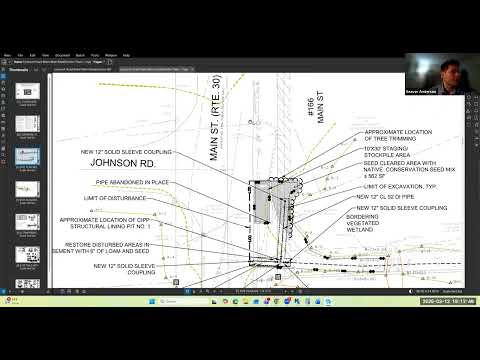
The project as presented would rehabilitate existing asbestos‑cement pipe the presenters said is more than 50 years old and, they said, would extend the pipe’s service life by roughly 50 years. Jason Anderson described a process of periodic excavation pits—placed about every 400 feet and sited outside stream channels when possible—to insert and receive the structural liner. PAR said the total excavation within the wetland buffer would be limited to about 280 square feet and that only the canopy along Main Street would need trimming for open‑cut work there.
The commission’s environmental reviewer, Joe Orzel, said he had not been able to field‑verify delineations because of snow cover but agreed the streams in the easement appear intermittent. Orzel asked the applicant to confirm whether a stream junction roughly 200 feet downstream would bring any riverfront area into the limit of work, to clarify an unlabeled buffer line on the plan (sheet C2.2), and to provide more detail on dewatering methods and the visible erosion‑control drawings.
PAR said the team had taken stream‑stats readings downstream of the Main Street culvert and would confirm distances; they offered to provide a written dewatering narrative or a plan detail quickly and said they could respond to commission‑requested conditions in a revised plan set. The presenters also noted MassDOT had provided comments for the state‑road portion of Lynnbrook and that a traffic plan would be required when construction is scheduled.
Commission discussion focused on whether a site visit was needed. Several commissioners said, given that the filing was submitted as a limited project under the Wetlands Protection Act (documented in the filing as "10.533 d"), and because the commission was not being asked to memorialize wetland lines, Joe Orzel’s comments could likely be addressed in revised plans rather than by an immediate site inspection.
The commission voted to continue the Lynnbrook hearing to the commission’s next scheduled session on April 30, 2026, and asked the applicant to submit final design plans, an updated narrative on dewatering, and corrected plan sheets addressing the delineation and erosion‑control map issues before construction begins.