Lifetime Citizen Portal Access — AI Briefings, Alerts & Unlimited Follows
Senate rules committee advances bill to move Oklahoma Medicaid expansion from constitution to statute
Loading...
Summary
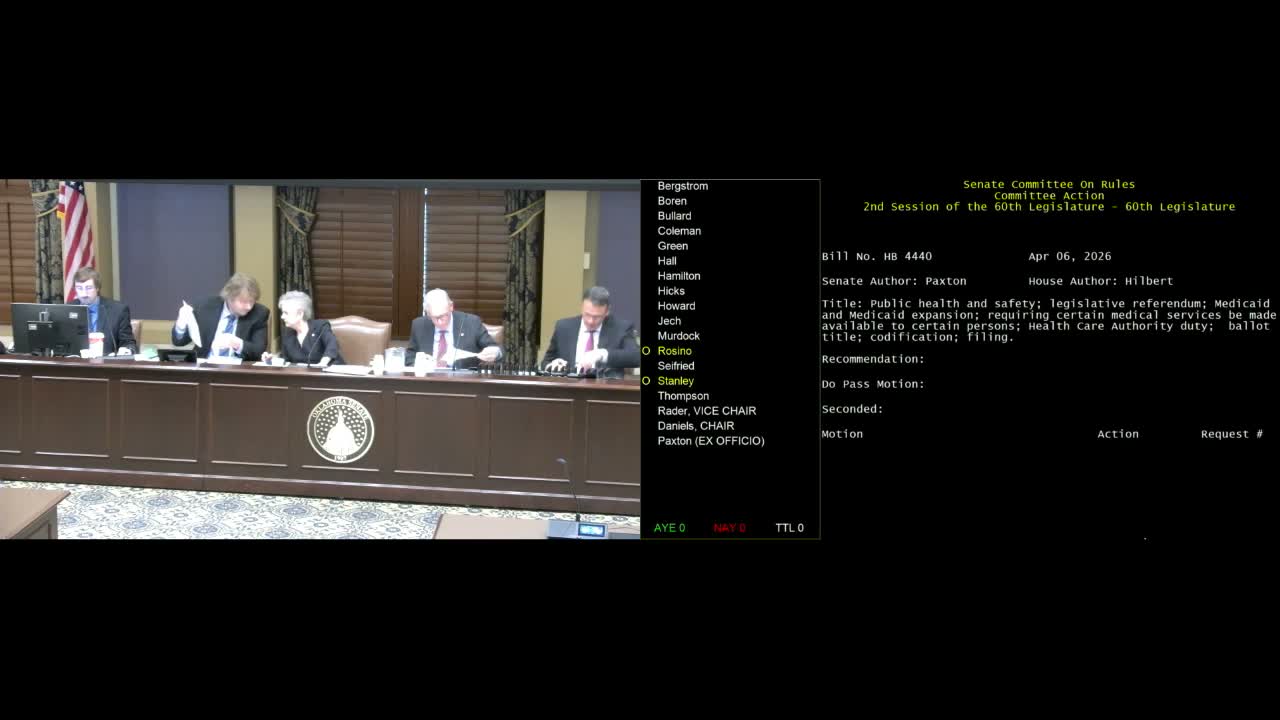
The Senate Rules Committee voted 14–2 to advance House Bill 4,440, which would repeal voter-approved constitutional language on Medicaid expansion and re-enact that language as statute, giving future legislatures the ability to change eligibility and benefits by majority vote.
Pro Tem Paxton told the Senate Rules Committee that House Bill 4,440 would repeal the constitutional provisions that enshrined Medicaid expansion (SoonerCare) and reenact the same substantive language as state statute so the legislature can manage the program.
Supporters said the change is about flexibility and fiscal management, not rolling back coverage. “This bill does absolutely nothing to cut Medicaid,” Pro Tem Paxton said, adding that moving the language into statute would give lawmakers tools to prioritize limited state resources if the federal match changed. He argued the legislature must be able to act if the federal government reduces its share of Medicaid costs.
Opponents warned the shift would remove a voter-protected guarantee. Senator Hicks urged a ‘‘no’’ vote, saying: “We are being asked to trade a voter protected promise for a legislative option,” and warned that moving the expansion into statute could open the door to eligibility cuts or new barriers for roughly 300,000 Oklahomans who depend on SoonerCare.
Lawmakers pressed the author on technical details and fiscal risks. Senators questioned whether the bill preserves the current 133% federal poverty threshold and whether the state would be protected if the federal match dropped (committee discussion referenced potential scenarios like a 90/10 to 60/40 shift). The author confirmed the bill keeps the 133% level in the statutory language now included but acknowledged that statutes can be changed by future legislatures through ordinary legislative processes.
The committee considered an amendment but voted to table it on a roll call. The Rules Committee then took a final roll-call vote and the chair announced that House Bill 4,440 passed committee by recorded vote, 14 ayes to 2 nays. The committee declared the bill to have passed committee and it will move forward in the legislative process.
The hearing record shows extensive questions about fiscal buffers, including references to a rate preservation fund and state savings the author described as roughly $3.5–$4 billion available for short-term shortfalls; the author characterized the $1,000,000,000 figure discussed during questioning as a potential annual state exposure under a hypothetical federal-match reduction.
The committee debate focused on competing framings: proponents emphasized budget flexibility and program management; opponents emphasized stability, voter intent and potential harms for rural providers and vulnerable populations. The committee did not adopt an amendment and the bill advanced out of committee.