Lifetime Citizen Portal Access — AI Briefings, Alerts & Unlimited Follows
Oklahoma Senate advances plan to move parts of Medicaid expansion out of the constitution; special‑election timing fails
Loading...
Summary
The Oklahoma Senate voted to advance House Bill 44 40, a measure that would send a state question to voters to remove language from the constitution that treats Medicaid expansion and traditional Medicaid populations identically; a separate vote to order a special election on the timing of that question failed after motions to reconsider.
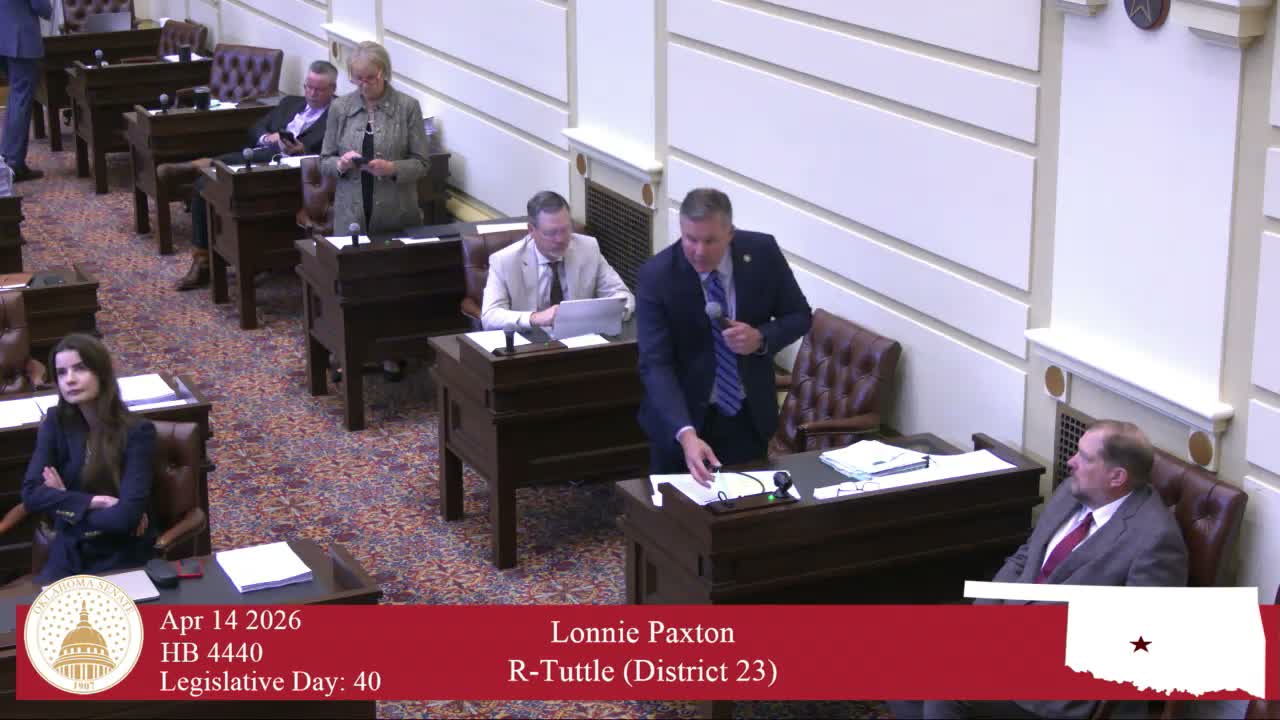
Pro Tem Paxton told the Senate that House Bill 44 40 would send a state question to voters to repeal the constitutional provision that “makes us treat both populations the same,” and would, if federal matching (FMAP) falls below 90%, move existing expansion language from the constitution into statute. "This simply lets us treat those populations different," Paxton said, arguing the change would give the Legislature managerial flexibility without repealing Medicaid expansion.
The bill author repeatedly cited a $494,000,000 invoice from the Oklahoma Health Care Authority as a fiscal stressor and said the state needs the ability to respond if federal matching declines. "If that ninety‑ten changes," Paxton said, "we have no control over that. We do have to be able to adjust what we do here to be able to manage that." He described the measure as a way to put the expansion in statute — as 38 other states do — while preserving coverage unless the Legislature acts otherwise.
Opponents said the move would strip voters’ protections and inject uncertainty into coverage for people who gained insurance through expansion. "This bill is about taking power away from the people," Senator Kurtz said during debate. Senator Goodwin warned that rolling back constitutional protection would put rural hospitals and vulnerable patients at risk, saying the change would turn “a constitutional guarantee into a political decision.” Other senators pressed the author for concrete savings estimates and for assurances that children, older adults and disabled people would keep access to care; Paxton repeatedly said those specifics would be addressed in future legislative work if the language moves to statute.
Senate floor action and votes: the chamber advanced House Bill 44 40 on third reading and recorded the initial passage tally on the floor. The Senate later held a separate, constitutionally required vote to order a special election on the amendment’s timing; that special‑election clause failed to reach the required two‑thirds vote and, after a motion to reconsider and a second roll call, failed again.
Why it matters: moving expansion language from the constitution to statute would make future adjustments subject to ordinary legislative procedure — a simple majority in both chambers and the governor’s signature — rather than the higher bar of a constitutional amendment. Supporters said that flexibility is needed to respond to a large, unpredictable invoice and potential federal funding changes; opponents said it weakens voter‑approved protections and could lead to reduced eligibility or benefits for people who rely on SoonerCare.
What’s next: the Senate voted to advance the bill for final processing and defeated the special‑election timing clause. Sponsors signaled they may pursue additional procedural steps in coming days; lawmakers also approved a separate joint resolution (HJR 1067) related to Medicaid expansion for the November ballot. Further legislative action or a voter decision would determine whether coverage rules are altered or remain intact.
Votes at a glance (floor‑reported tallies from the session): - House Bill 44 40 (advance on third reading): reported on the floor as passed by recorded roll (floor announcement of the tally during session). The chamber separately voted on the special‑election provision; that proposition failed to obtain the required supermajority on the recorded roll and was announced as failed after reconsideration votes on the floor. - House Joint Resolution 1067 (November ballot option): passed on third reading (floor‑reported tally recorded during the session).
The Senate also advanced a package of pension, appropriations and agency budget limit bills on the same floor calendar day; those measures were considered and recorded separately.