Get Full Government Meeting Transcripts, Videos, & Alerts Forever!
Get email alerts on the Legislative Oversight topic
No spam. Unsubscribe anytime.
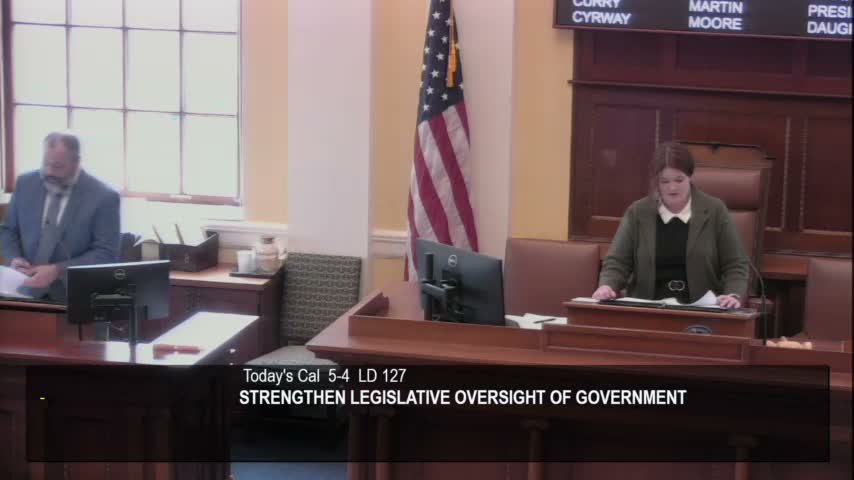
Senate floor debate focuses on restoring legislative access to confidential records; minority report rejected
Summary
Lawmakers spent hours debating LD 127, a bill that would clarify the Government Oversight Committee’s access to confidential agency records. The Senate rejected the minority report (10–24) and moved to consider committee amendment A; supporters said oversight was impaired, critics warned of harm to vulnerable families.
The Maine Senate spent a large portion of its session debating LD 127, legislation described by supporters as restoring the Legislature’s ability to access confidential records for oversight, and by opponents as a threat to the privacy of families involved in child-welfare cases.
Senator Carney of Cumberland, who led the committee’s minority report in support of a balanced approach, said the minority position “recognizes that effective oversight requires both access to information and respect for the confidentiality of third parties who are drawn into those investigations through no fault of their own.” She added that Committee Amendment B preserves confidentiality while allowing members to prepare for public hearings.
Senator Hickman urged colleagues to view the measure as an assertion of legislative power. Quoting legal precedent, he warned that recent court rulings have restricted oversight tools and said the bill is about ‘‘our power as elected members of the legislative branch’’ to conduct oversight.
Proponents stressed child-safety concerns raised by government oversight work. Senator Timberlake recounted child-fatality cases and said: “LD 127 lets the government oversight committee look behind that iron curtain of what’s happened… Not only at DHHS, but any other department in the state of Maine.” He said executive resistance to sharing files left lawmakers unable to discover what happened in multiple child deaths.
Opponents and child-welfare advocates raised privacy concerns. Senator Carney read language from a letter submitted by the Maine Children’s Alliance and the Maine Child Welfare Action Network arguing that making confidential case records available to committee members could deter families from engaging with child-welfare services and ‘‘make children less safe.’’ Senator Dusan, who has experience running a state agency, spoke to both sides: he said OPEGA’s redacted reports helped fix agency problems in his prior role but cautioned about revealing raw family records to elected officials.
On procedure, the Senate rejected the minority-ought-to-pass motion by recorded vote (10 in favor, 24 opposed). Following that result, the body moved to consider Committee Amendment A and took steps to give the bill a second reading by title; the clerk read the bill as "An act to strengthen legislative oversight of government agencies and programs by reaffirming the legislature's access to confidential records." The transcript shows the Senate voted to advance the measure to engrossment and concurrence proceedings and read committee amendment A, but a final floor tally for ultimate enactment is not recorded in the provided transcript segment.
Why it matters: LD 127 addresses the boundaries between legislative oversight and confidentiality protections in sensitive cases — particularly child-protection files — and responses to the law court’s recent ruling. Supporters say the measure restores tools the Legislature needs to hold agencies accountable; critics say it risks revealing medical, trauma and proprietary information and could chill reports to child-protection systems.
What’s next: The Senate record moves the bill forward with committee amendments read and procedural steps taken; the transcript does not include the final enactment vote within the provided segments.