Get Full Government Meeting Transcripts, Videos, & Alerts Forever!
Get email alerts on the Public Private Partnerships topic
No spam. Unsubscribe anytime.
Council hears progress reports on waterfront Neby Park and 180‑acre Skyhill/Terra Nova project
Summary
Deputy city manager and committee representatives updated the council on the Kachigo/Cachigo waterfront (Neby Park) — a 29‑acre, city‑owned project with an estimated $20 million public infrastructure investment funded by a TIF — and an overview of the Littleworth Road/Skyhill (Terranova) multi‑phase private development that includes up to 800 residential units and 600–800k square feet of commercial/industrial space.
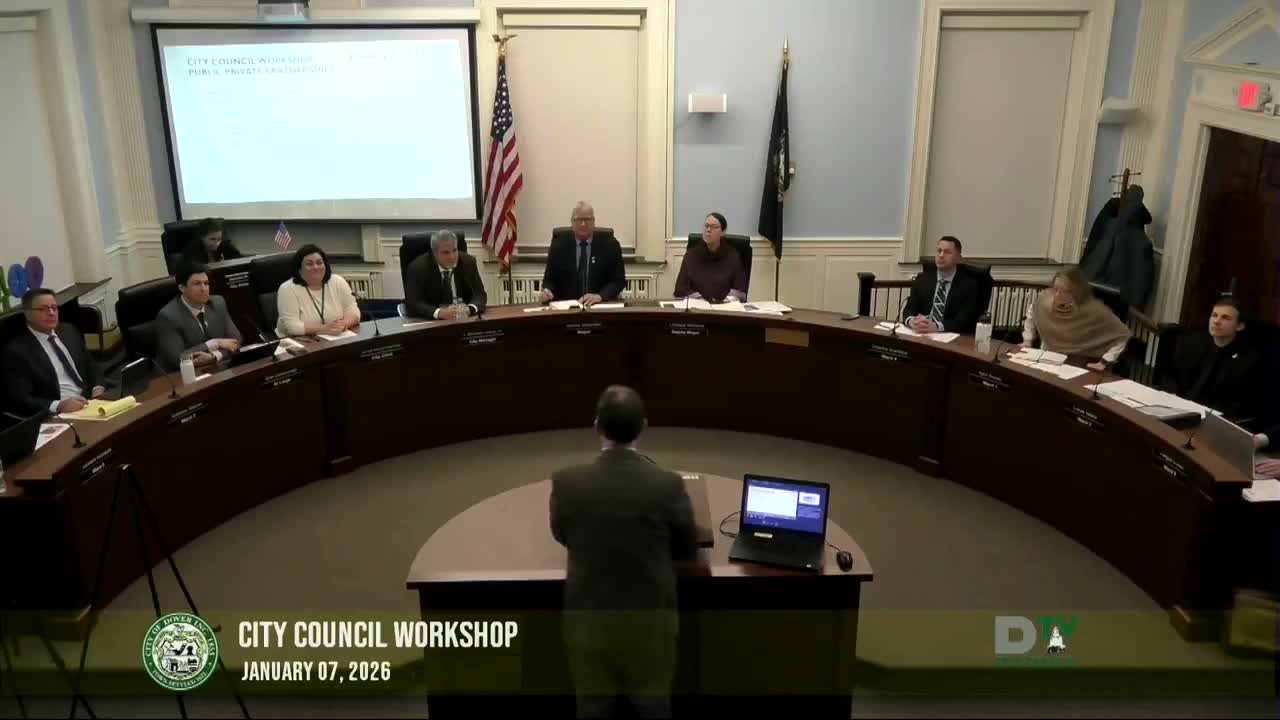
City staff and project partners gave the Dover City Council a status update on two long-running public–private partnerships: the waterfront/Neby Park project and a large mixed-use Littleworth Road project marketed as Skyhill (formerly Terranova).
Deputy City Manager Christopher Parker framed the discussion around the city’s use of public–private partnerships as a tool to invest in public infrastructure that enables larger private development. He said the waterfront project centers on a 29-acre city-owned parcel adjacent to the river and includes park improvements (Neby Park), a public pavilion, public art bases and mixed-use private buildings. "It is approximately $20,000,000," Parker said of the public infrastructure investment, which staff said will be funded through a tax increment financing (TIF) district to pay for streets, utilities and remediation.
Norm Fracaza, chair of the waterfront advisory committee (QUITIC), described the committee’s role in representing community vision, preserving river access and advising on park elements, including locating the pavilion and ensuring public access points. Staff said utilities and road improvements are in place, the pavilion is nearly complete, and several residential buildings are approaching certificates of occupancy; park elements and a grand opening are anticipated in coming months.
On the Littleworth Road/ Skyhill (Terranova) project, staff described a multi‑parcel plan for roughly 180 acres and up to 800 residential units with 10% "attainable" units, 14+ acres of public open space and a phased reimbursement model in which the developer constructs infrastructure and the city reimburses from tax revenues as valuation is realized. Staff emphasized that many requirements—buffers, conservation easements and phasing—are codified in the development agreement and that planning‑board review and state permitting (e.g., DES, NHDOT) remain necessary steps.
Developer representatives said portions of the site were previously clear-cut before their ownership and described plans for technical design, neighborhood meetings for abutters and a goal to begin construction in 2026 following planning approvals. Staff said the city negotiated additional buffers near sensitive abutters (for example, extending a 50-foot code buffer to 150 feet in one area and recording open-space easements). Councilors raised questions about traffic mitigation, parking, transit access for future employment areas and whether conversions (for example to hotel uses) would require additional approvals; staff said those changes would require additional site-plan and council review.
Next steps: staff will return with specific requests as they come forward to the planning board and council, and the city manager reiterated that public–private partnerships let the city "keep a seat at the table" while leveraging private investment and limiting immediate taxpayer exposure.