Get Full Government Meeting Transcripts, Videos, & Alerts Forever!
Get email alerts on the Higher Education topic
No spam. Unsubscribe anytime.
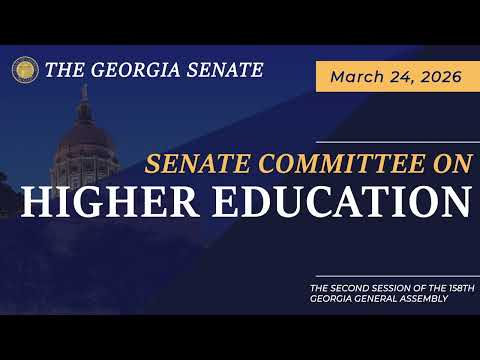
Senate higher-education panel advances committee substitute consolidating Dream Scholarship, Narcan access and retirement housekeeping
Summary
A Senate higher-education committee unanimously adopted an amendment and advanced a committee substitute that combines parts of four bills to create a consolidated Dream Scholarship package while excluding two contested sections for further work: a 529 tax-parity change and a medical-scholarship funding detail. The panel also heard testimony urging campus Narcan access and resisted immediate inclusion of tax-parity language.
A state Senate higher-education committee voted unanimously to advance a committee substitute that consolidates four bills into a single Dream Scholarship package and approved an amendment changing lottery-reserve language.
The committee chair said the substitute (LC610500S) bundles elements of HB 1413, HB 419, HB 1113 and HB 962 and will be sent to the Senate floor; the panel adopted an amendment revising how the lottery reserve is calculated to read, as amended, “net proceeds deposited into or base spend from such account for the preceding 3 fiscal years, whichever is greater.” Legislative counsel read the amendment on the floor before the vote. The committee recorded the adoption and the subsequent passage of the substitute by uplifted hands; exact tallies were not provided in the transcript.
Why it matters: the composite bill is intended to create a single implementable Dream Scholarship framework while packaging several related higher-education measures so the Senate can act efficiently. The substitute keeps in place changes to lottery reserve calculations intended to protect pre-K and HOPE spending if lottery revenue declines.
What the substitute includes and excludes - Narcan access on campuses: The consolidated bill includes language from HB 419 that would allow Narcan (naloxone) cabinets or distribution in university and technical-college buildings where AEDs exist; Representative Hawkins presented the measure and said it is funded through community donations rather than a state fiscal note. "Narcan is a very safe drug," Hawkins said, and the bill would include liability protections for personnel who administer it.
- Retirement-code housekeeping: The substitute carries forward the HB 1113 amendment to the Georgia defined-contribution plan that explicitly excludes part-time student workers from plan membership; proponents said this codifies an existing practice and that TCSG and the University System of Georgia are in agreement.
- 529 parity and Path to College discussion (excluded from the substitute): The committee debated HB 962’s proposal to let Georgia taxpayers claim the state deduction for contributions to out-of-state 529 plans. An author argued parity gives Georgians choice; opponents, including Bethany Wetzel of the state treasurer’s office, urged caution. Wetzel testified that the Path to College plan is currently the second-lowest-cost plan nationally (average fee roughly 8.3 basis points) and that advisor-sold plans commonly charge much higher fees (about 84 basis points), and said parity would reduce funds the treasurer uses for outreach and seed deposits for families and people with disabilities. For that reason, the committee left Section 2 of HB 962 out of the consolidated substitute for further work.
- Medical scholarships for underserved areas (set aside for further work): The committee discussed — but did not include — Section 2 of HB 1413, a proposed medical scholarship program tied to service in underserved areas. The author said lottery funds could be used though no allocation exists in the current budget; committee discussion put the estimated annual cost roughly at $30,000 per student for public medical programs and described the award as a service-obligation scholarship requiring a repayment or refund if service terms are not met or the recipient leaves the state.
Key exchanges and claims - Public-health urgency: Jeff Breedlove, representing the American Addiction Recovery Association and the Georgia Council for Recovery, urged passage of the Narcan measure and said, "we're averaging 200 overdoses a day in the United States," calling campus access to naloxone a life-saving measure.
- Treasurer’s caution on 529 parity: Bethany Wetzel of the Office of the State Treasurer said tax parity would undercut the treasurer’s ability to seed accounts and run outreach; she warned advisor-sold plans tend to be much more expensive than the state plan.
Vote, motions and next steps - Amendment adopted: Senator Harrell moved the amendment revising the lottery-reserve language; legislative counsel read the change and the committee adopted the amendment by an uplifted-hand vote.
- Committee passage: With the amendment adopted, the committee voted to pass the committee substitute for HB 1413 as amended. The transcript records the votes as unanimous by uplifted hands; no roll-call tally was read.
What remains unresolved - The committee explicitly left out the 529-parity language (HB 962 Section 2) and Section 2 of HB 1413 on medical scholarships for additional work and potential future inclusion.
The committee chair praised the authors and said more work remains on the Senate and House floors; the panel adjourned and canceled the next scheduled higher-education meeting.
Sources and attribution: Quotes and attributions come from committee members, witness testimony and legislative counsel recorded in the committee transcript. Quotations are attributed to speakers recorded as Jeff Breedlove (recovery advocacy), Bethany Wetzel (Office of the State Treasurer), Representative Hawkins (author of HB 419) and Senator Harrell (mover of the amendment).