Lifetime Citizen Portal Access — AI Briefings, Alerts & Unlimited Follows
Subcommittee hears calls to boost supportive‑housing services as federal funding faces cuts
Loading...
Summary
Presenters from the Corporation for Supportive Housing, Avalon Housing and Room at the Inn urged the House Appropriations Subcommittee on Human Services to preserve and expand supportive‑services funding, citing local outcomes and a $20 million FY27 request to sustain programs amid risks to HUD Continuum of Care grants.
The House Appropriations Subcommittee on Human Services heard presentations from the Corporation for Supportive Housing (CSH), Avalon Housing and Marquette’s Room at the Inn urging state support for services that keep people housed and reduce downstream public costs.
Catherine DeSlerath of CSH told members that supportive housing pairs affordable units with case management and other services and that Michigan faces affordability pressures: she said a two‑bedroom rental in Michigan now requires nearly $24.50 per hour to afford. DeSlerath outlined recent state appropriations for supportive services — noting FY23 funding of $6,000,000, a FY24 supplemental originally $20,000,000 (the transcript indicates $10,000,000 ultimately distributed) and a $5,000,000 FY26 renewal — and asked the committee to consider a $20,000,000 request for FY27 to expand and sustain services.
DeSlerath also warned that recent U.S. Department of Housing and Urban Development (HUD) changes to Continuum of Care (CoC) funding could reduce awards for permanent housing; she said an earlier HUD notice that would have capped permanent housing at 30% of a CoC’s total award threatened a potential $56,000,000 shortfall and put more than 7,000 Michigan households at risk of losing housing if those cuts materialize in 2027.
"Supportive housing is affordable housing plus services," DeSlerath said. "It helps people stay housed and reduces reliance on emergency systems." She cited state and national research showing decreased emergency department visits, arrests and jail stays among supportive‑housing participants and said those reductions translate into cost offsets for the state.
Avalon Housing’s Molly Smith described Avalon’s housing‑first service delivery and cited local outcomes. "We combine permanent affordable homes with services that are tailored to keep people stably housed," Smith said. She said Avalon currently serves roughly 900 individuals and families (about 200 children) and reported an average service cost of about $13,000 per person per year compared with roughly $37,000 per person per year for emergency shelter costs.
Smith described the Supportive Services Transformation Fund (SSTF) as a critical state resource that lowered caseloads and supported staff retention and capacity building, and she highlighted specific outcomes from SSTF‑funded work (higher housing retention rates and increases in access to health insurance and benefits through SOAR assistance).
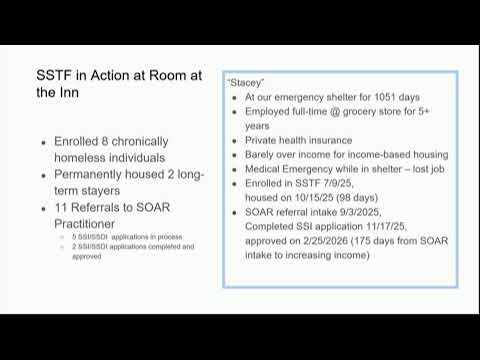
Chelsea Wilkinson of Room at the Inn spoke for a rural perspective and described how small providers use SSTF to stand up services in places with scarce rental stock and limited partner capacity. Wilkinson said her program served over 350 families in 2025, was using SSTF to launch a permanent supportive‑housing program that enrolled eight chronically homeless people and had placed two long‑term shelter residents into housing since launching the program.
Wilkinson shared a client example: a woman the presenter said had been in shelter for roughly 1,000 days and who was housed in 98 days after being enrolled in the program; Wilkinson also credited a SOAR practitioner for expediting SSI approval for some clients.
Members asked clarifying questions. Representative Kelly asked about "LIHTC," and presenters explained it is the Low Income Housing Tax Credit, a principal source of capital financing for affordable housing. Another member asked about using Medicaid billing codes to pay for supportive services; presenters said a small number of providers have piloted billing the supportive‑housing codes but that successful billing depends on contractual relationships with local Community Mental Health agencies and on CMH budget capacity to reimburse providers.
The Subcommittee did not take formal action on funding at the hearing. Chair Roth thanked the presenters, noted written testimony in committee packets and adjourned the meeting.
Next steps: presenters requested that the Legislature consider sustaining and expanding SSTF or a comparable recurring line to preserve services if federal CoC funding remains constrained. Written testimony and supplemental materials were left with the committee for further review.